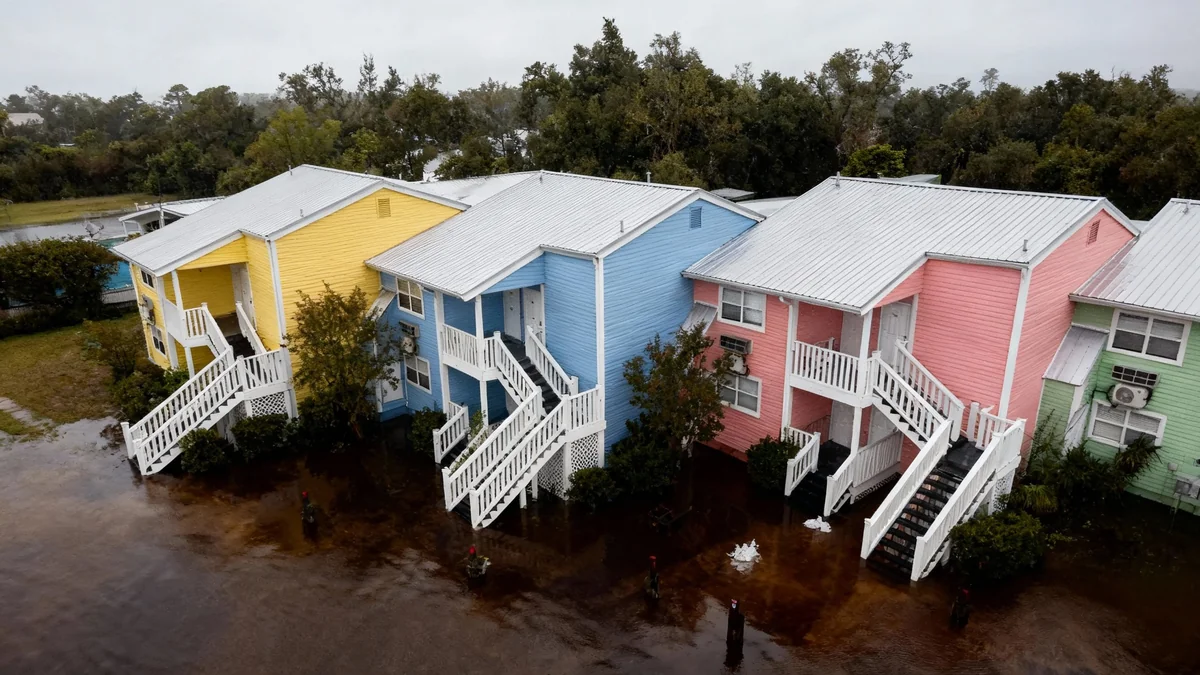
Major real estate platform Zillow has removed climate risk scores from its property listings, a move that has sparked a broad conversation about how homebuyers access information on environmental threats. While the data has been taken down, the underlying risks from floods, fires, and extreme weather remain, leaving many to question the reliability of the tools used to measure them.
The decision followed a complaint from a major real estate listings aggregator that questioned the accuracy of the risk assessments. This development highlights a growing challenge in the property market: balancing the need for transparent climate information with the reality that the science of predicting risk at a hyper-local level is still evolving.
Key Takeaways
- Zillow removed climate risk scores from its website in November following concerns about data accuracy from a real estate industry aggregator.
- Studies show significant inconsistencies among different climate risk models, with one analysis finding that two models agreed on flood risk only 21% of the time.
- Experts argue that while the models are imperfect, greater transparency about environmental risks is essential for a healthy housing market.
- The debate occurs as other sectors, like energy and shipping, also grapple with adapting to climate-related economic shifts.
The Challenge of Inconsistent Data
For potential homebuyers, a score that quantifies a property's risk from future flooding or wildfires can seem like an invaluable tool. However, the models that generate these scores are far from standardized, often leading to contradictory and confusing results.
An industry group in the United Kingdom recently conducted a study to test this variance. The Climate Financial Risk Forum asked 13 different climate-risk companies to rate the same 100 properties located around the world. The outcomes were strikingly inconsistent.
For some properties, one model would assign a high vulnerability to flooding while another model indicated no risk at all. The discrepancies highlight that climate risk modeling is a relatively new field where established norms have yet to be formed.
A Tale of Two Cities
To test the models' geographic accuracy, the UK study provided incomplete location data for 20 properties. In one case, a model incorrectly placed a well-known store in Boston, Massachusetts, on a street with a similar name in Atlanta, Georgia, demonstrating the potential for significant errors.
These inconsistencies were a key factor in the data's removal from property sites. The California Regional Multiple Listing Service, a major aggregator, reported finding that many homes were assigned very high flood probabilities despite having no history of flooding for decades. Art Carter, the service's CEO, stated that these findings made them "grow very suspicious" of the data's reliability.
Market Impacts of Imperfect Information
The core issue is that financial decisions worth hundreds of thousands of dollars are being influenced by this emerging science. Oversimplifying or misrepresenting climate projections can have serious consequences, potentially devaluing some assets unfairly and distorting market pricing.
"The fundamental problem here is that you have properties that in a fixed period of time are going to have no real value because of the risk of fire or flood," Rhode Island Senator Sheldon Whitehouse has stated, emphasizing the long-term financial stakes tied to climate change.
"‘Climate risk’ is much more than just the physical hazard. The relationship of hazard and the built environment — and damage — is the actual risk."
Adam Pollack, incoming assistant professor at the University of Iowa
Experts argue that risk is not just about the existence of a hazard like a flood, but how that hazard interacts with a physical structure. Adam Pollack, an incoming assistant professor, developed an open-source software tool to help researchers and companies better understand the uncertainties related to buildings themselves.
Ultimately, a healthy real estate market depends on trustworthy information. While no homeowner wants to see their property value decrease, hiding potential risks doesn't make them disappear and can lead to greater financial instability in the long run.
A Push for Better Standards
Despite the current challenges, many experts agree that providing consumers with climate risk information is a positive step. The goal now is to improve the quality and transparency of that information.
"Greater transparency around climate risks, the general public being aware of flooding risks when they’re buying a property — I think that’s brilliant," said Oliver Wing, chief scientific and product officer at Fathom, a flood modeling company. He described it as a "force for good in aggregate."
The central question, according to Wing, is determining the appropriate level of model output disclosure for the public domain. Finding that balance will be critical to empowering consumers without causing undue alarm or financial harm based on models that are still being refined.
Broader Climate and Economic Shifts
The conversation around climate risk in real estate is part of a larger global reckoning with the economic impacts of a warming planet. Other industries are also navigating significant transitions.
- Battery Technology: Competition and new chemistries are expected to drive down battery pack prices by another 3% in 2026 to an average of $105 per kilowatt-hour, aiding the transition to electric vehicles and grid storage.
- Shipping Industry: Companies like bound4blue are developing modern sail technology, using large, tube-like structures to reduce vessel fuel consumption by up to 40%.
- National Policy: The Trump administration's new national security plan has largely dismissed climate change as a priority, instead focusing on "energy dominance" through fossil fuels, a stark departure from the previous administration's strategy.
The Future of Home Buying in a Changing Climate
The removal of climate scores from Zillow is not the end of the story but rather the beginning of a new chapter. It has forced a necessary conversation about data integrity, scientific transparency, and consumer protection in an era of increasing environmental uncertainty.
For now, homebuyers are left to seek out information from other sources, such as federal flood maps or local disclosures, which may not provide the same forward-looking analysis that the risk models attempted to offer.
As the science of climate modeling matures, the industry will likely see a return of these tools, hopefully with greater standardization and clearer explanations of their limitations. Until then, the principle of "buyer beware" takes on a new and urgent meaning as climate change continues to reshape the landscape of the housing market.