
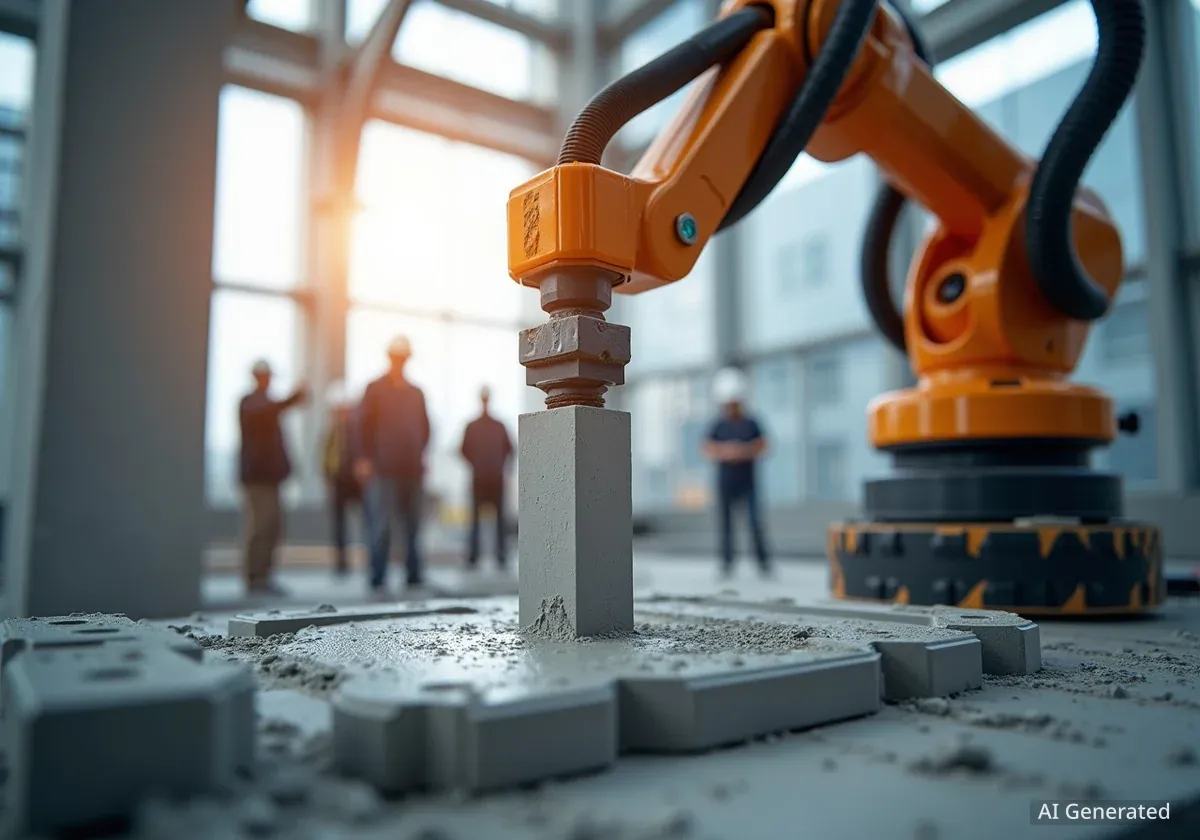
Walmart is significantly expanding its use of 3D printing for commercial construction, partnering with Alquist 3D to build more than a dozen new facilities. This move signals a major step forward for a technology that has, until now, been primarily used in the residential housing sector.
The expansion follows a successful pilot project in Athens, Tennessee, which resulted in the largest 3D-printed commercial structure in the United States. The new agreement aims to streamline construction, reduce costs, and address ongoing labor shortages in the building industry.
Key Takeaways
- Walmart is commissioning over a dozen new 3D-printed buildings from construction technology firm Alquist 3D.
- The technology significantly speeds up construction, with one 5,000-square-foot project completed in just seven days.
- This initiative marks one of the largest commercial deployments of 3D printing, a technology mostly confined to homebuilding.
- A new partnership with materials giant Sika is expected to lower costs and improve the sustainability of the concrete mixes used.
A New Era for Commercial Construction
The partnership between Walmart and Alquist 3D is set to change the landscape of commercial real estate construction, an industry known for its slow adoption of new technologies. The initial project, an almost 8,000-square-foot addition to a Walmart store in Athens, Tennessee, served as a crucial test case.
This facility, designed for online order pickup and delivery, demonstrated both the potential and the challenges of scaling up 3D printing for large commercial applications. Patrick Callahan, CEO of Alquist, described the first build as a learning experience.
"It was a sort of classic Silicon Valley failing forward job," Callahan said, acknowledging the initial hurdles. "Nobody had ever done this before."
Despite the initial learning curve, the partners quickly refined their process. A subsequent 5,000-square-foot pickup center in Huntsville, Alabama, was completed in a mere seven days, showcasing the technology's remarkable speed and efficiency once mastered.
From Residential Prototypes to Retail Giants
While 3D printing has gained attention for creating affordable and unique homes, its application in the commercial sector has been limited. The primary obstacle has been the sheer size of the printers required to construct larger buildings like warehouses and retail centers.
Alquist, which designs its own large-scale printers and the software to run them, is one of the few companies bridging this gap. By focusing on volume, the company aims to make the technology more accessible and affordable.
Why 3D Printing is Gaining Traction
Traditional construction faces challenges like rising material costs, lengthy project timelines, and a persistent shortage of skilled labor. 3D printing offers potential solutions by automating parts of the building process, reducing waste, and requiring smaller, more specialized crews.
Scaling Up with Strategic Partnerships
To support its nationwide expansion with Walmart and other retailers, Alquist has secured a critical partnership with Sika, a global leader in construction materials. Sika will provide specialized concrete mixes for all of Alquist's future projects, a move expected to create a more reliable and cost-effective supply chain.
"This collaboration positions Sika at the forefront of next-generation construction, opening new markets and creating long-term growth opportunities," said Noah Callantine, a 3D concrete printing specialist with Sika.
Callahan explained the importance of this volume-driven approach. "The way to bring prices down for anything is to get volume, and as you get volume, you get the attention of suppliers," he noted. "They see that it matters, and the more that they make, the cheaper that they can bring their supply chain down."
Fact: The first Walmart-Alquist project in Athens, Tennessee, is the largest 3D-printed commercial structure in the United States, measuring nearly 8,000 square feet.
Addressing the Construction Labor Shortage
A key advantage of 3D printing is its potential to alleviate the severe labor shortages plaguing the construction industry. While the technology requires fewer workers on-site, those roles are more technical, involving robotics and software operation.
Callahan, whose background is in defense technology, sees this as an opportunity to attract a new generation of workers to the construction field. Alquist is partnering with trade schools to develop curricula focused on robotics and sustainable materials.
"You’re not necessarily throwing rocks around up on a scaffolding, but using robotics in a safe, clean environment," Callahan said. "We’ve seen a lot of what used to be traditional construction folks that kind of pushed back, they’re now leaning in."
This shift could redefine construction jobs, making them more appealing to tech-savvy individuals and creating a new pipeline of skilled labor.
The Broader Industry Takes Notice
Alquist is not the only company pushing the boundaries of 3D printing. Icon, a major player in the residential 3D printing market, is also exploring commercial applications. The company has already completed a hotel project and is reportedly in talks to build data centers.
Jason Ballard, Icon's co-founder and CEO, believes the industry is at a tipping point. He anticipates that the company's new, larger "Titan" printer will unlock the potential for most types of industrial buildings.
"I think we should expect to see a lot of interest in alternative ways of construction, data centers and other kinds of commercial things as well," Ballard stated. He projects that Icon could grow by over 300% next year as the technology proves its value beyond pilot projects.
As major retailers like Walmart adopt 3D printing, the technology is moving from a niche concept to a viable, mainstream solution for commercial construction, promising a future of faster, more efficient, and more sustainable building.