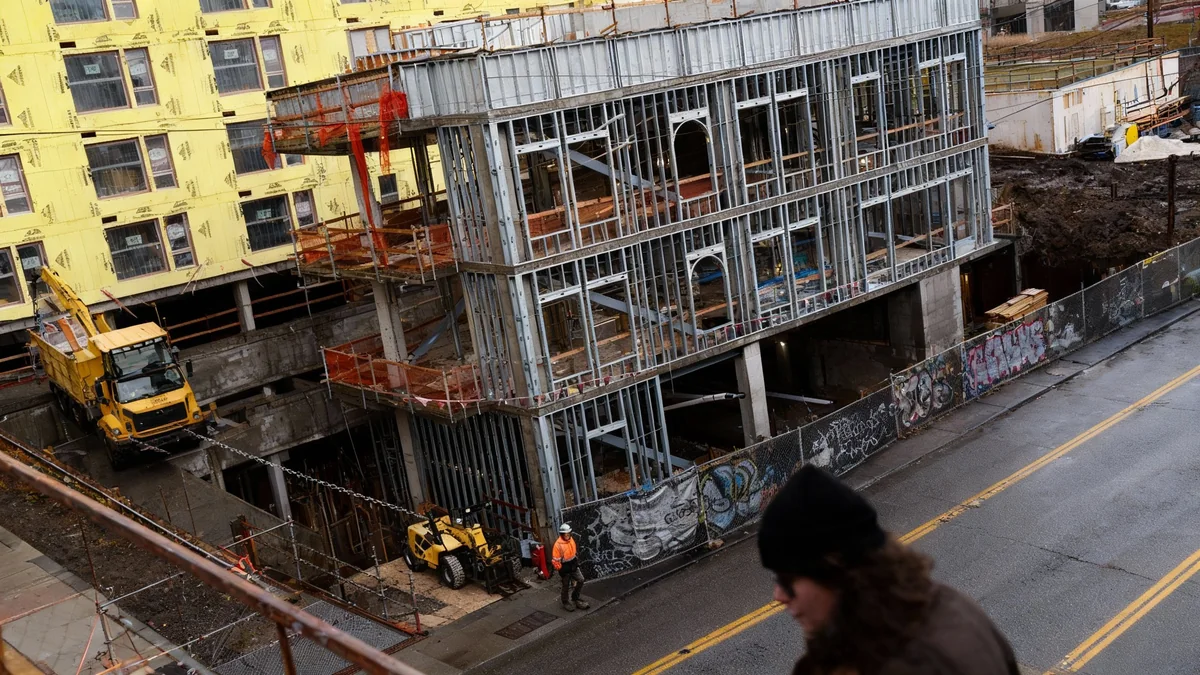
A nationwide push to build more housing was expected to bring down costs for everyone. However, new research indicates that in cities with aggressive construction, rents have stabilized for the wealthy but have continued to climb for low-income households, revealing a critical mismatch in the housing market.
The problem lies in what is being built: developers are overwhelmingly focused on luxury units and larger single-family homes. This strategy targets young professionals and affluent buyers, leaving families and individuals with modest incomes behind in an increasingly expensive market.
Key Takeaways
- Despite a construction boom in major cities, rents for low-income households have risen sharply, while stabilizing for wealthier renters.
- Newly built housing often consists of luxury studios and one-bedrooms, which are too expensive and small for families with lower incomes.
- In cities like Phoenix, vacancy rates for new units are high, yet the number of affordable units has decreased significantly.
- Skyrocketing insurance costs are a major driver of rising operating expenses for landlords, further pushing up rents for all tenants.
The Great Disconnect: More Buildings, Higher Rents
For years, the prevailing wisdom has been that the solution to the housing crisis is simple: build more. The theory suggests that increasing supply will eventually lead to lower prices for all. But a January report from the Georgetown Center on Poverty and Inequality challenges this narrative. By analyzing federal data from 2015 to 2023, researchers found a troubling trend in six metro areas that built more housing than the national average: Atlanta, Dallas, Houston, Phoenix, Seattle, and Washington, D.C.
In these cities, even as the overall housing supply grew, the number of units affordable to lower-income households either fell or remained stagnant. The new construction was predominantly aimed at the high end of the market.
"You can’t just build, build, build and think it’s going to work out for everybody in the end. You need to think about what you’re building and who you’re building it for."
- Lelaine Bigelow, Executive Director, Georgetown Center on Poverty and Inequality
This focus on luxury development is a direct result of economic pressures. Developers often state that high-end projects are necessary to make their numbers work, covering the high costs of land, materials, and labor. This leaves a significant gap in the market for affordable options.
A Tale of Two Cities in Phoenix
The situation in Phoenix provides a stark example of this disparity. The city saw a significant increase in new housing, yet the benefits were not shared equally. The vacancy rate for newly constructed units climbed to over 9 percent, suggesting a surplus of housing that isn't meeting the needs of the local population.
Phoenix Market Snapshot (2015-2023)
- Rent for lowest-income households: Increased by 26.7%
- Rent for highest-income households: Decreased by 5.3%
- Units available for those earning <$30,000/year: Fell by 27%
While high-income renters saw their costs decrease, those in the lowest income brackets faced a sharp 26.7% rent hike. At the same time, the number of units available to people earning less than $30,000 a year plummeted by 27%. This data illustrates that new supply alone does not guarantee affordability for those who need it most.
The Limits of 'Filtering'
Proponents of the 'build more' strategy often point to a phenomenon known as filtering. The idea is that as wealthier renters move into new luxury apartments, their older, less expensive units become available for people with more modest incomes. This trickle-down effect is meant to eventually create more affordable options across the market.
However, experts caution that filtering has its limits, especially in high-cost cities. Dan Emmanuel, director of federal research at the National Low Income Housing Coalition, notes that the process can break down. The cost of operating and maintaining an older building, including taxes, utilities, and repairs, can be so high that landlords cannot lower rents enough to be truly affordable for the lowest-income households while still turning a profit.
"The filtering process can break down or even reverse," Emmanuel said, suggesting that without direct intervention, the market alone cannot serve the most vulnerable renters. This is why public funding and subsidies for dedicated affordable housing remain critical components of any comprehensive solution.
The National Affordability Crisis
The strain on household finances is a nationwide issue. In 2024, nearly half of all American renters were considered cost-burdened, spending over 30% of their income on housing. For households earning less than $30,000 a year, the figures are even more dire: 83% are cost-burdened, and 67% are severely burdened, spending more than half their income on rent.
The Invisible Crisis: Soaring Insurance Costs
Beyond the type of housing being built, another powerful force is driving up rents: the rapidly increasing cost of property insurance. A separate report published on February 5 by Enterprise Community Partners, a national affordable housing nonprofit, highlights this growing crisis.
The report found that in 2023, many affordable housing providers saw their insurance premiums jump by 25% or more, with some facing rate doubles. These dramatic increases in operating costs put immense pressure on landlords, both in the affordable and market-rate sectors.
"We’re in the middle of, arguably, the deepest affordability crisis we’ve had in our lifetimes," said Shaun Donovan, president of Enterprise Community Partners and a former Secretary of Housing and Urban Development. "And the fastest growing cost in housing is insurance."
A Structural Problem with Long-Term Consequences
Market-rate landlords facing these skyrocketing costs have few options. They can pass the increases on to tenants through higher rents, delay essential maintenance, or, in extreme cases, abandon their properties altogether. For subsidized affordable housing operators, the situation is even more precarious, as their ability to raise rents is limited. The Enterprise report found that rising operating costs have already pushed some affordable housing providers into bankruptcy.
Donovan emphasized that this is not a temporary issue. "The factors that are driving this are not cyclical, they are also structural," he stated. This suggests that without significant changes in policy and the insurance market, rising costs will continue to threaten the stability of both existing and future housing stock, making the path to affordability even more difficult for millions of Americans.