
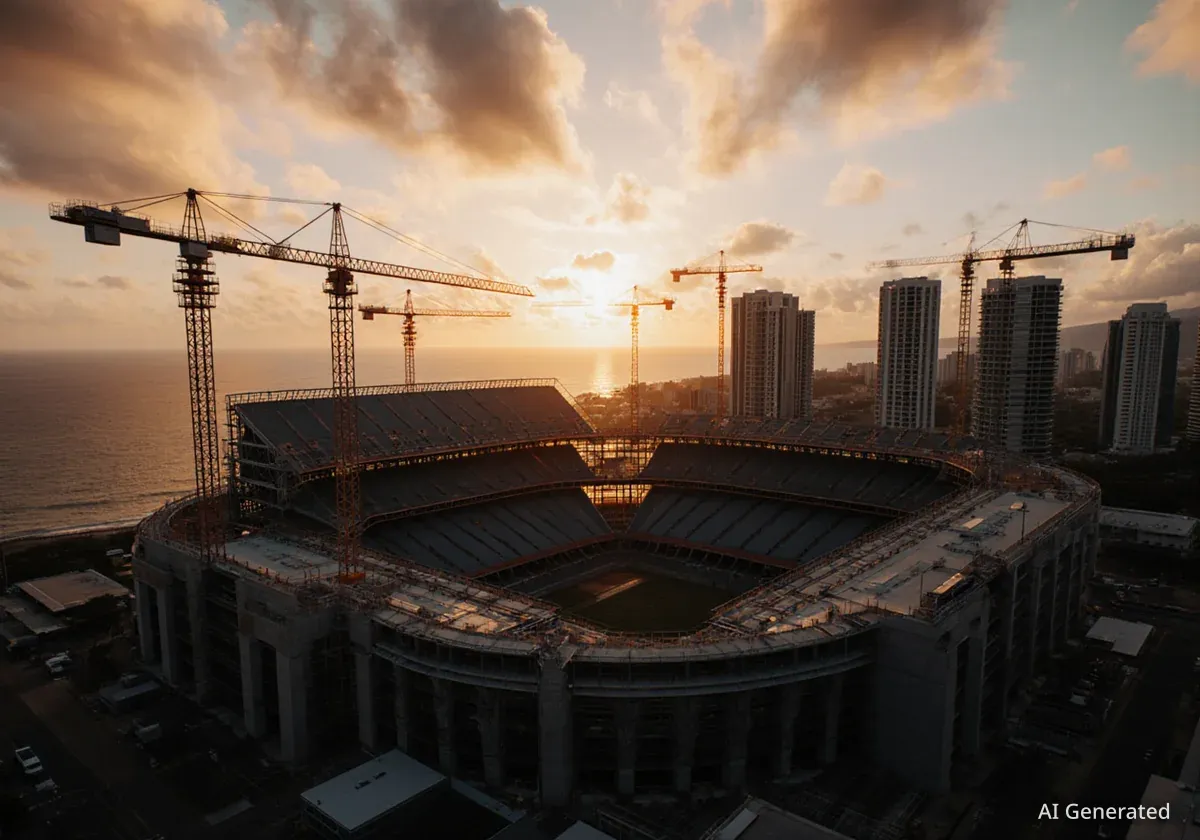
Hawaii's Department of Accounting and General Services (DAGS) is proposing the creation of a specialized in-house team to oversee major state construction projects, starting with the multi-billion dollar New Aloha Stadium Entertainment District. The plan, which seeks nearly $730,000 in its first year, aims to reduce the state's reliance on costly private consultants.
The proposal includes three new high-paying positions, with one executive role offering a salary comparable to that of the governor. State officials argue that investing in permanent staff with expertise in complex public-private partnerships will ultimately save taxpayers money on massive undertakings like the new stadium and a planned correctional facility.
Key Takeaways
- Hawaii's DAGS wants to create a new special projects branch to manage large-scale developments.
- The initial annual cost for the three-person team is estimated at $729,000.
- The team's first major task would be overseeing the New Aloha Stadium Entertainment District (NASED).
- The move is intended to curb the state's spending on private consultants, which has already reached nearly $50 million for the NASED project alone.
A Plan to Reduce Consultant Spending
State officials are making a case to lawmakers for a new approach to managing Hawaii's most ambitious and expensive public works. The Department of Accounting and General Services has pitched a plan to establish a permanent special projects branch within its Public Works Division.
The core objective is to build internal expertise for navigating complex public-private partnerships. Currently, the state heavily relies on external consultants for this specialized work, a practice that has proven costly.
By the Numbers
The state has already spent nearly $50 million on private consultants for planning, design, and environmental studies related to the New Aloha Stadium Entertainment District project.
DAGS Director Keith Regan explained the rationale to legislative committees, emphasizing the increasing complexity of modern state projects. He highlighted the need for dedicated, in-house staff to guide these initiatives from start to finish.
“These projects are becoming more and more complex,” Regan stated during a briefing. “We’re essentially contracting for this work. We want them in-house. We want them to be our people in-house being able to guide us through these complex projects.”
The proposal has garnered early support from key lawmakers who oversee the state budget. Senator Donovan Dela Cruz, chair of the Senate Ways and Means Committee, described the current situation as needing a course correction.
“We have to stop the bleeding with the contracting,” said Sen. Dela Cruz. Acknowledging the high salaries proposed, he added, “There is some sticker shock initially. But however when you talk about how much we spent on NASED already and consultants, that’s been almost ($50 million). And so this will hopefully bring it back in so we can get control of cost.”
The Proposed Expert Team
The initial phase of the plan calls for hiring three highly skilled professionals. The total annual cost for this team is projected to be approximately $729,000, which includes salaries and operational expenses.
The proposed positions and their annual salaries are:
- Special Project Executive: $220,000
- Senior Project Manager: $160,000
- Cost Management Specialist: $139,000
The salary for the special project executive is notable, as it is comparable to the annual salary of Governor Josh Green. This reflects the high level of expertise the state is seeking to attract for managing projects with budgets in the hundreds of millions, and even billions, of dollars.
If the Legislature approves funding for the fiscal year beginning July 1, DAGS anticipates filling the positions by the end of 2026. Regan suggested that once the team is in place, the department can begin to phase out its reliance on external consultants for NASED and subsequent projects.
Focus on the Aloha Stadium Megaproject
The immediate priority for this new branch would be the New Aloha Stadium Entertainment District (NASED). This massive redevelopment initiative involves more than just replacing the aging stadium in Halawa.
Understanding the NASED Project
NASED is a two-part endeavor. The first involves a private consortium, led by developer Stanford Carr, designing and building a new stadium with $350 million in public funds. The second, more extensive part, is a long-term plan to transform the surrounding state land into a vibrant community with housing, retail, hotels, and restaurants. This broader development is estimated to cost between $5 billion and $6 billion over 25 years.
The sheer scale and financial complexity of NASED underscore the state's motivation for creating a dedicated management team. Written materials from DAGS state that the new branch will provide “specialized attention, expertise, and resources on complex initiatives, ensuring more effective planning, oversight, and delivery.”
Beyond the Stadium
While NASED is the catalyst, the special projects branch is envisioned as a permanent fixture to handle a pipeline of future large-scale projects. Officials have already identified several other initiatives that would fall under the team's purview.
These include:
- The construction of a new Oahu Community Correctional Center, with an estimated cost of around $1 billion.
- Renovations to the state Capitol building.
- The redevelopment of the Kinau Hale building, which houses the state Department of Health.
During legislative briefings, Senator Angus McKelvey, who chairs the Senate Committee on Government Operations, even suggested that the branch could eventually be expanded to include a state architect position. The proposal now awaits consideration by the full Legislature as it begins its new session.