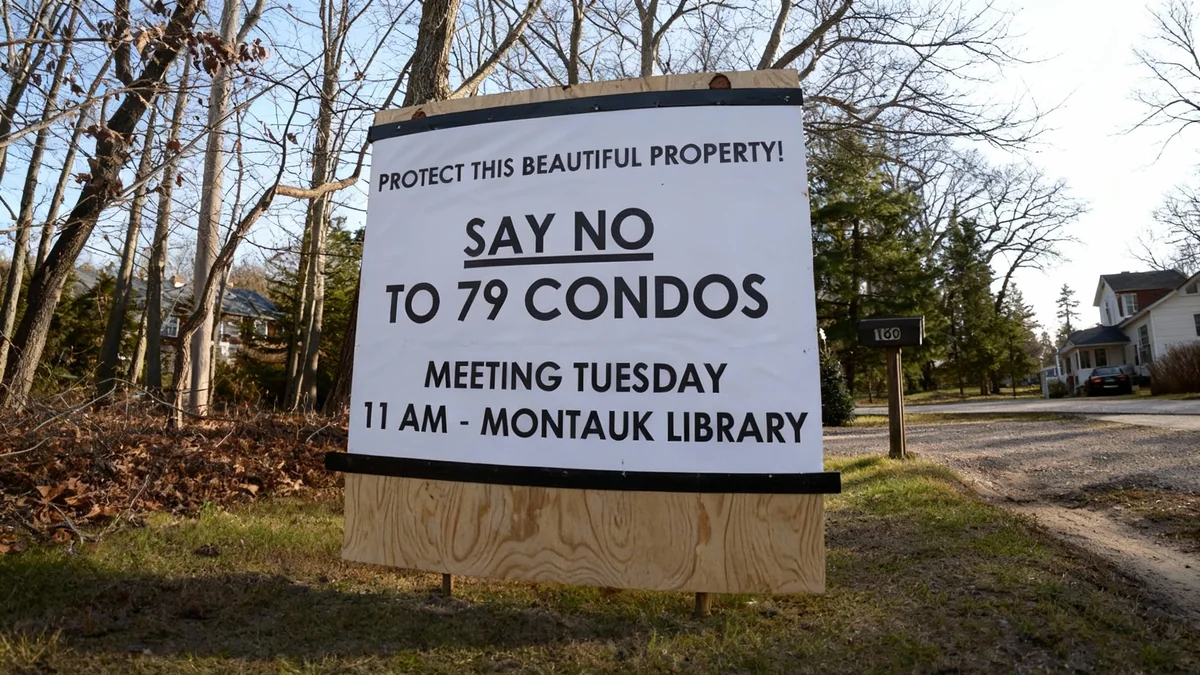
A proposal to build 79 affordable condominiums in East Hampton was withdrawn just one week after its introduction, following intense opposition from local residents and business owners. The plan, aimed at addressing the area's severe housing shortage for local workers, sparked a community-wide debate over development, affordability, and neighborhood character.
Developer Kirby Marcantonio presented the project for two parcels of land on Three Mile Harbor Road and West Drive on December 2. By December 8, after a petition against the development gathered nearly 3,000 signatures, the proposal was officially dead, highlighting the deep divisions within the community on how to solve its housing crisis.
Key Takeaways
- A plan for 79 affordable condos in East Hampton was withdrawn within a week due to public outcry.
- An online petition started by a local business owner attracted nearly 3,000 signatures opposing the project.
- The developer's model, which involved selling units to employers for their workers, was a major point of contention.
- East Hampton town officials ultimately did not support the proposal, citing concerns over density and its definition of 'affordable housing'.
A Swift and Decisive Community Response
The project's journey from proposal to collapse was remarkably short. On December 2, developer Kirby Marcantonio detailed his vision to the East Hampton Town Board. His plan involved rezoning two adjacent land parcels, listed for a combined $5.62 million, into an Affordable Housing Overlay District to allow for higher density.
Marcantonio argued that the project was a private-sector solution to a public crisis. He pointed out that many essential workers, including police officers, are forced to commute long distances due to the high cost of living in East Hampton.
"The driving force behind this is this idea that the private sector can help provide housing in an area where housing is far beyond the reach for most anybody," Marcantonio stated, emphasizing the difficulty local businesses face in hiring and retaining staff.
However, word of the proposal spread quickly. Residents expressed alarm, not at the idea of affordable housing itself, but at the scale and structure of this specific project. The plan to sell condos directly to businesses, which would then house their employees, became a central point of criticism.
The Power of a Petition
The opposition crystallized on December 4 when Carolyn Snyder, owner of the popular Round Swamp Farm market located next to the proposed development site, launched a Change.org petition. Titled "DENY the Zone Change Request for 79 Condos," it rapidly gained traction.
By the Numbers
- 79: The number of proposed condominium units.
- 1 Week: The time between the proposal's introduction and its withdrawal.
- 2,700+: The number of signatures on the petition opposing the development by December 8.
- $5.62 Million: The combined asking price for the two land parcels.
The petition articulated fears of overcrowding and argued that the project did not represent true affordable housing. One signatory, Bonny, commented, "I know housing is short but this is not about affordable housing. This is about overcrowding … Who will want to be in the Hamptons if it looks like Far Rockaway?"
The sentiment was echoed by a homeowner living near the site who wished to remain anonymous. "He wants to build these condos to sell it to business people out there for probably $750,000 to $1 million each," the resident claimed. "That’s not what’s affordable." Marcantonio has denied this characterization of the pricing.
The overwhelming response demonstrated a unified front from a segment of the community, forcing officials and the developer to take notice.
Official Response and Project Withdrawal
Faced with mounting pressure, the East Hampton Town Board made its position clear. On Monday, December 8, Town Supervisor Kathee Burke-Gonzalez issued a statement effectively ending the project's chances.
"I do not support the Petition for 152 Three Mile Harbor Road and 33 West Drive. The proposed model does not meet our definition of affordable housing … placing 79 units at this location would not reflect the character of the neighborhood. Because a majority of the Town Board does not wish to pursue this Petition, it will not move forward."
Around the same time, Marcantonio and his partners met privately and decided to withdraw their contract to purchase the land. "It was pretty clear that that neighborhood would prefer to just have us step back," he explained, acknowledging the community's firm stance.
Even after the withdrawal, tensions remained high. At a town board meeting on December 9, Brian Niggles, speaking for his family who owns Round Swamp Farm, expressed the community's relief and lingering anxiety. "It’s given all of us a lot of turmoil in our lives... I think that it would give all of us a lot of comfort if this nightmare would be finally put to bed," he said.
The Unresolved Housing Dilemma
While this specific project has been halted, the underlying issue of housing affordability in East Hampton persists. The debate has exposed a critical challenge: residents agree that a problem exists, but consensus on a solution remains elusive.
A Tale of Two Projects
While the Three Mile Harbor Road proposal failed, Kirby Marcantonio has another affordable housing project in development at 350 Pantigo Road. This 45-unit townhouse project is moving forward because the land was already zoned for affordable housing and is in a more isolated location, avoiding a contentious rezoning battle.
Marcantonio highlighted the severity of the problem, noting that two-thirds of the local workforce commutes up to 50 miles. He also mentioned that "half the police force of East Hampton lives in Smithtown because they can’t afford to live here."
The developer remains committed to finding solutions, even if this particular site is no longer an option. His team is proceeding with a separate 45-unit affordable housing project on Pantigo Road, a parcel that has been zoned for such use for 40 years.
For now, the land next to Round Swamp Farm will remain undeveloped. The week-long saga serves as a powerful case study in community activism and the complex politics of development in one of America's most exclusive areas. As Marcantonio concluded, "If that’s not the spot, maybe we could find something else. We’ll try."