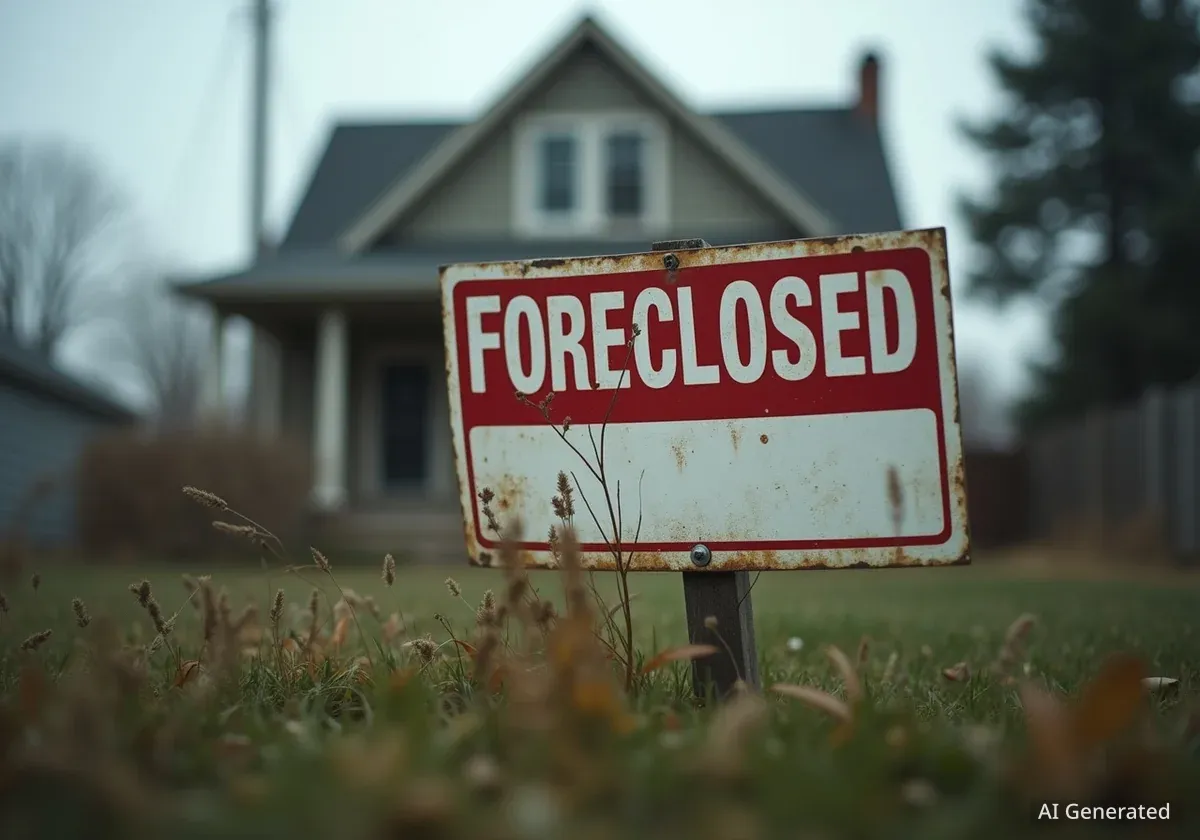
Foreclosure activity across the United States saw a significant increase in November, jumping 21% compared to the same month last year. This marks the ninth consecutive month of year-over-year increases, indicating ongoing financial strain for some homeowners.
Real estate data firm ATTOM released a report detailing the rise in default notices, scheduled auctions, and bank repossessions. This trend could impact the housing market, which has faced low inventory levels and high prices for prospective buyers.
Key Takeaways
- Foreclosure activity increased by 21% in November compared to last year.
- This marks the ninth straight month of annual increases in foreclosures.
- Delaware, South Carolina, Nevada, New Jersey, and Florida experienced the highest rates.
- The impact on housing supply will vary by state due to different foreclosure laws.
- Government-backed FHA loans show higher rates of delinquency and foreclosure.
Foreclosure Activity Continues Upward Trend
The latest data shows a clear pattern of rising foreclosures throughout 2025. In November, approximately one in every 3,992 U.S. housing units received a foreclosure filing. This includes properties entering the default process, those scheduled for auction, and homes that banks have repossessed.
Rob Barber, CEO at ATTOM, noted that this data points to a market normalization. He explained that some homeowners are struggling with increased housing costs and broader economic pressures. This financial stress can influence credit conditions and overall housing affordability.
November Foreclosure Snapshot
- Overall Increase: 21% higher than November last year
- Monthly Filings: 1 in every 3,992 U.S. housing units
- Consecutive Increases: Ninth straight month of year-over-year rises
Regional Impact and State Law Differences
The effect of rising foreclosures on housing supply will not be uniform across the country. Local laws and market conditions play a significant role in how quickly distressed properties reach the market.
States with the highest foreclosure activity in November included Delaware, South Carolina, Nevada, New Jersey, and Florida. Major metropolitan areas like Philadelphia, Las Vegas, Cleveland, Orlando, and Tampa also reported elevated activity.
"Rising foreclosure rates may add some inventory to the for-sale market, but ATTOM’s data trends show that current increases remain well below historic highs, limiting their overall impact," said Rob Barber.
Barber also highlighted that any increase in housing supply from foreclosures is likely to be localized. It will be concentrated in areas where delinquency and foreclosure rates are accelerating faster than the national average.
Judicial Versus Non-Judicial Foreclosures
The timeline for a foreclosed home to enter the market varies greatly depending on state laws. This is due to differences in judicial and non-judicial foreclosure processes.
In judicial states, such as Delaware, South Carolina, and Florida, lenders must file a lawsuit in court to initiate a foreclosure. This process can extend beyond a year. Conversely, non-judicial states like Nevada and California do not require a court order, allowing properties to reach the market in just a few months.
Understanding Foreclosure Processes
Judicial Foreclosure: Requires court involvement, typically longer timelines (over a year). Lenders must prove the homeowner defaulted in a court of law.
Non-Judicial Foreclosure: Does not require court involvement, generally faster (a few months). Lenders follow specific state procedures, often involving a trustee.
These variations mean that price effects from foreclosures show up at different times in different markets. Stricter regulations, longer timelines, or weak local demand can delay the number of distressed properties that become active listings.
Growing Disparity and FHA Loans
Recent data indicates a concerning trend among borrowers with government-backed Federal Housing Administration (FHA) mortgage loans. These loans, often utilized by first-time homebuyers, are showing higher rates of delinquency and foreclosure activity.
This situation highlights a growing economic disparity. Analysts suggest that lower-income homebuyers, who often rely on FHA loans, are facing greater financial challenges compared to wealthier homeowners. The rise in FHA loan foreclosures contributes to the overall increase in distressed properties.
The broader economic implications are significant. Rising foreclosures can signal financial stress among households, which in turn affects credit conditions and the overall resilience of the economy. Buyers and investors should monitor local data closely, as nationwide trends may not fully reflect specific market conditions.
What This Means for Prospective Homebuyers
For years, homebuyers have grappled with high prices and limited housing options. While the increase in foreclosures might suggest more inventory, experts caution against expecting a sudden market shift.
Any additional supply from foreclosures will likely be localized. Buyers in specific high-foreclosure areas might find more options, but the national impact on prices and inventory remains constrained. Understanding local market dynamics and state foreclosure laws is crucial for anyone considering buying a foreclosed home.
This ongoing trend in foreclosures underscores the importance of financial stability for homeowners. As economic pressures continue to evolve, the housing market will likely see continued adjustments, with varying effects across different regions and demographic groups.