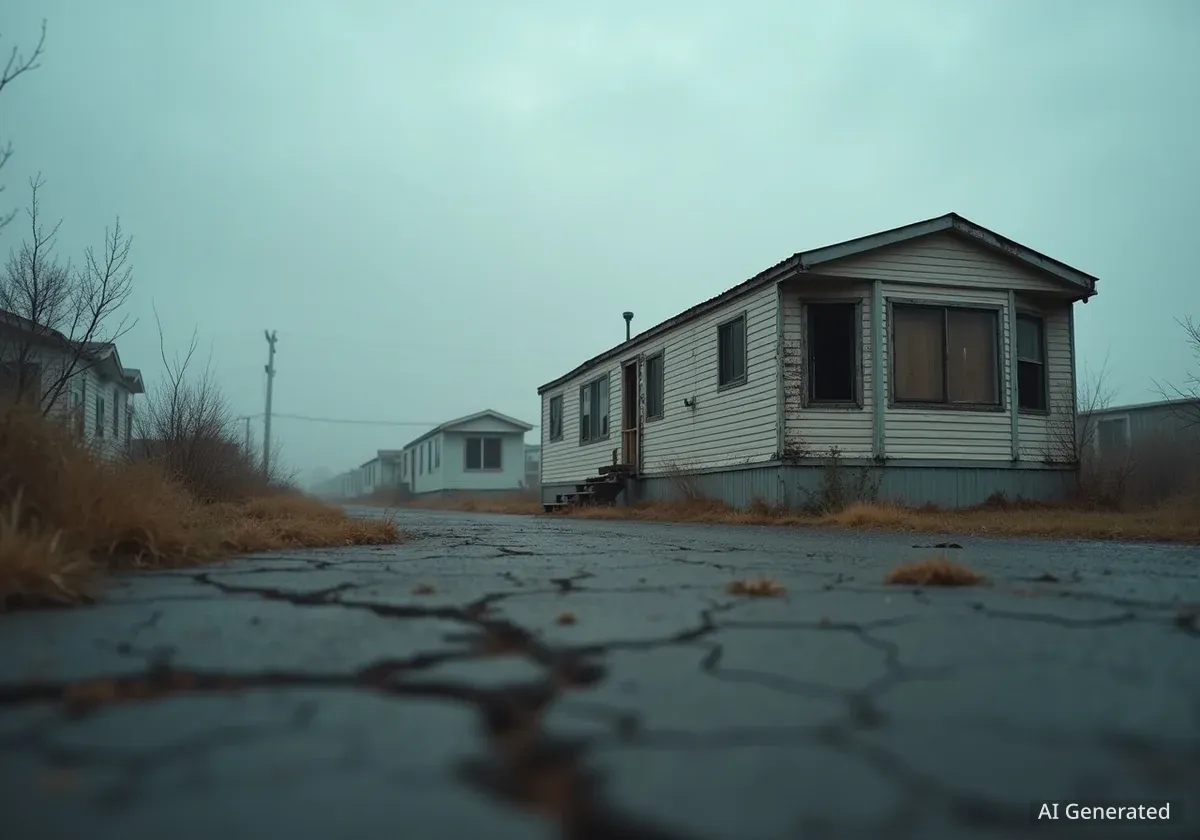
Months after city officials in Toledo, Ohio, declared the Riverside Mobile Home Park "unfit for human habitation," a small group of residents continues to live on the property. Faced with a lack of affordable housing alternatives, they remain in the condemned park even as the water supply has been cut off and demolition crews are on standby.
The situation highlights a growing crisis in affordable housing, where even in markets considered inexpensive, low-income individuals on fixed budgets are struggling to find safe and accessible places to live. The park's owners are attempting to sell the property for $750,000 while facing significant unpaid bills and taxes.
Key Takeaways
- Several residents remain at the Riverside Mobile Home Park in Toledo, four months after it was condemned by the city.
- The property has no running water, and residents cite a lack of affordable housing as the reason for staying.
- The park's owners owe nearly $250,000 in unpaid water bills and property taxes and face a potential $200,000 demolition lien.
- The case underscores the vulnerability of mobile home residents and the broader affordable housing shortage in the U.S.
A Property in Decline and a City's Response
The decision to condemn the Riverside Mobile Home Park was the result of a long period of decline and neglect, according to city officials. The property's owners, a Chicago-based firm, have not paid property taxes since 2018, based on public records.
In a press release, Toledo Mayor Wade Kapszukiewicz stated that the owners had not met fundamental safety standards. "For too long, the owners of Riverside Mobile Home Park have failed to meet even the most basic standards of safety and decency," he said.
An agent representing the owners told local news outlet 13 Action News that the property was inherited in poor condition and that the owners did not have the financial resources to make necessary improvements. This lack of investment ultimately led to the city's intervention.
The Condemnation Order
The city's Department of Building and Code Compliance issued the condemnation order to protect the health and safety of the people living there. The conditions were deemed a significant risk to the well-being of the residents.
"This is not a decision we make lightly," said Jim Molnar, the director of building and code compliance. "But the conditions at this property are unacceptable and pose a real danger to the health of those still living there. This action is necessary to protect people and ensure they have the opportunity to live in a safe and healthy environment."
Residents were initially given a 30-day notice to leave and were offered connections to local agencies for relocation assistance. The deadline was extended from June until late September, but as that date passed, three tenants were still living on the site.
Residents Caught in a Housing Crisis
For the remaining inhabitants of Riverside, the situation has become a difficult waiting game. They express a desire to leave but are trapped by economic realities. The soaring cost of rental housing has made finding a new home nearly impossible for those on limited incomes.
Susan Luttrell, one of the residents, explained her financial constraints to local media. "We're trying all the time to find a place," she said. "All the rents are so high. When you're on Social Security, under $1,000 a month, you can't pay $800 a month on rent. You can't do it."
Financial Strain on Residents
- Many residents, like Susan Luttrell, live on fixed Social Security incomes of less than $1,000 per month.
- Average rental prices in many areas now consume a large majority of such an income, leaving little for other necessities.
Another resident, Charles Parker, voiced frustration with the relocation process. "They send us here, they send us there, they tell us to talk to this person, talk to that person," he stated. "You can talk all you want. It's action that matters." Parker added that the residents are the ones who ultimately bear the consequences. "We're the ones that suffer, we're the ones that are losing everything that we've put in," he said.
The National Context of Mobile Home Ownership
The challenges faced by the residents of Riverside are not unique. They reflect a systemic issue within the American housing market, particularly for the 22 million Americans who live in mobile and manufactured homes. This form of housing has historically been one of the most affordable options available.
A Vulnerable Housing Model
A common arrangement in mobile home parks is that residents own their physical home but rent the plot of land it sits on. This hybrid ownership model leaves them with the responsibilities of a homeowner but with fewer legal protections. They are vulnerable to sharp increases in lot rent, park sales to developers, or evictions, which can result in the loss of their primary asset—their home.
Research from Princeton's Eviction Lab has highlighted this vulnerability. Jacob Haas, a researcher with the lab, told Realtor.com that eviction rates in some mobile home parks are three times higher than the foreclosure rates for traditional homes. When a park is sold or rents increase, residents can lose everything, even if they own their home outright.
While the Riverside situation is a government-led condemnation rather than a landlord-initiated eviction, the outcome for residents is functionally the same: the loss of a home with few affordable alternatives available.
Toledo's Affordability Paradox
On a national level, Toledo is often cited as one of the country's more affordable housing markets. However, this broad characterization does not reflect the reality for all of its residents, especially those with low or fixed incomes.
Economic factors complicate the picture. In March, Toledo's unemployment rate was 6.6%, significantly higher than the national rate of 4.3%. According to Realtor.com Chief Economist Danielle Hale, this was driven by job losses in professional services, information, and manufacturing sectors. While the city's overall low cost of living may attract new homebuyers, it offers little relief to longtime residents who are being priced out.
The standoff at Riverside Mobile Home Park serves as a stark example of this paradox. It demonstrates how fragile the last footholds of affordable housing can be, even in a city known for its relative affordability. For the few residents remaining, the struggle is not just about finding a new place to live, but about navigating a system where the next affordable option may not exist.