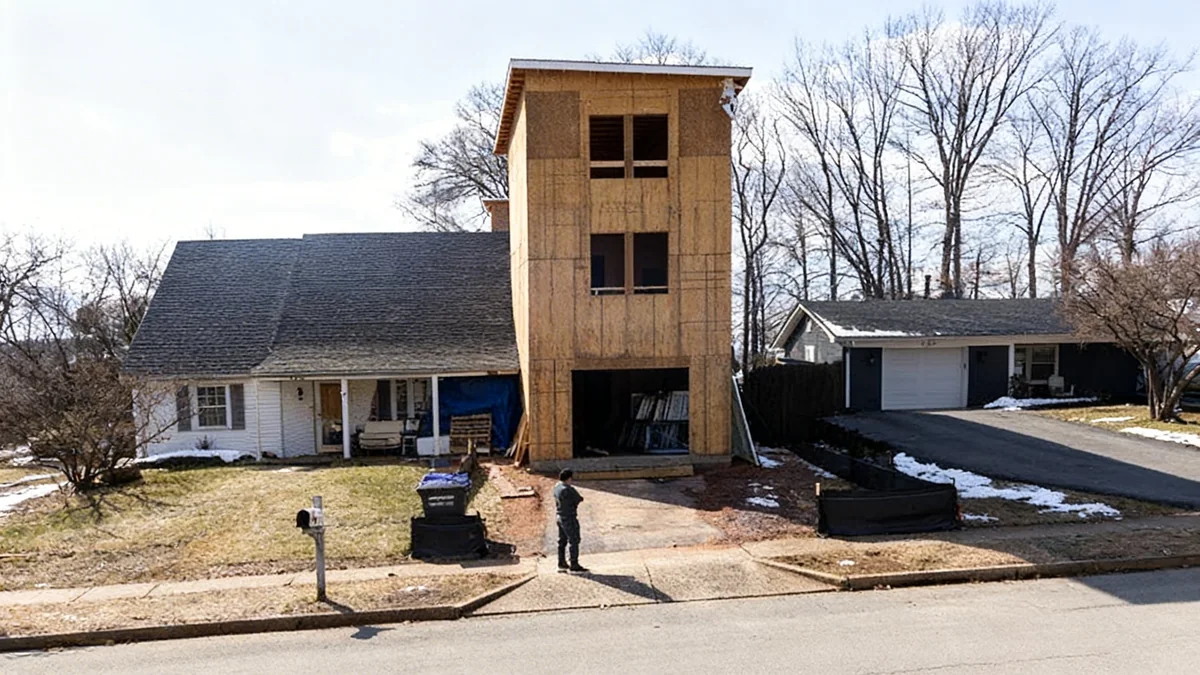
In a quiet suburban neighborhood in Fairfax County, Virginia, a partially built three-story home addition stands as a monument to a growing national conflict. What began as one family's solution to housing needs has escalated into a community-wide debate, pitting neighbor against neighbor and questioning the very rules that govern how American suburbs evolve.
The structure, built by homeowner Minh Nguyen to accommodate his multigenerational family, has been halted by county officials following neighbor complaints and viral social media attention, leaving both families in limbo and a nearly $400,000 project hanging in the balance.
Key Takeaways
- A 3,000-square-foot, three-story home addition in Fairfax County, Virginia, was halted mid-construction after neighbor complaints.
- The homeowner, Minh Nguyen, spent nearly $400,000 on the project, which was initially approved by the county.
- The dispute highlights a national tension between the need for increased housing density and the preservation of suburban neighborhood character.
- County inspectors later found the structure was 7.2 inches too close to the property line, leading to a stop-work order.
A Plan for Family Becomes a Point of Contention
For Minh Nguyen, the plan was straightforward. He needed more space for his growing family, which includes his wife, two young children, and his immigrant parents from Vietnam. The solution was a 3,000-square-foot, three-story addition to his home in the Greenbriar neighborhood.
After hiring a surveyor and an engineer, Nguyen submitted detailed plans and received a building permit from Fairfax County in August of last year. Construction began, and the structure started to take shape. “It’s weird — I know that,” Nguyen acknowledged of the large, boxy design. “But it fits the needs of my family.”
However, for his next-door neighbor, Courtney Leonard, the scale of the project was alarming. As the structure rose, it formed what she described as a wall between their homes. The addition of the third floor was the final straw. “How are we going to live with that?” she recalled thinking.
The Push for Denser Housing
The situation in Fairfax County reflects a broader trend across the United States. Municipalities are actively encouraging denser housing to combat shortages and rising costs. Fairfax County itself updated its zoning code in 2021 to make it easier to build accessory dwelling units (A.D.U.s), a response to a population that grew from 819,000 in 1990 to 1.15 million in 2020.
From Local Dispute to Viral Sensation
The conflict gained significant public attention after drone footage of the towering addition was posted to Facebook on November 15. The 20-second video quickly went viral, attracting over 1,600 comments. Online observers compared the structure to a small apartment complex or a budget hotel.
The increased scrutiny prompted Fairfax County officials to re-examine the project. In an email to the county, Leonard expressed her “deep frustration and disappointment with this situation.” Initially, officials told her there was nothing they could do, as the project had been approved.
But under growing pressure, the county requested additional surveys. These new measurements revealed a critical error: the addition was 7.2 inches too close to Leonard’s property line, violating the side yard setback requirement.
Inspectors also identified structural issues, noting the walls were not properly prepared to withstand lateral forces from events like high winds or earthquakes. This combination of findings led to a complete stop-work order on November 24, 2025.
Living in the Aftermath
Today, the construction site is frozen in time. Strips of house wrap hang from the unfinished exterior. Inside, finished stairs lead to rooms that have no doors or windows. The project's halt has left both families in a difficult position.
Nguyen’s family endured a harsh winter using space heaters because a new HVAC system meant for both the original house and the addition was never installed. The financial and emotional toll has been immense. “My family just went through hell,” Nguyen said, adding that he has faced insults from strangers who drive by to see the controversial structure.
Leonard is also living with the consequences. The massive, unfinished wall looms over her single-story home, casting long shadows across her property. “It feels like we’re literally living in the shadows,” she stated. She worries that her rooftop solar panels are now ineffective and that parts of her home have become damp and cold due to the lack of sunlight.
“I certainly place some blame on the county for allowing it to get this far,” Leonard said, a sentiment Nguyen shares.
A Broader Debate on Neighborliness and Zoning
The dispute has become a case study in the clash between zoning laws and the unwritten rules of community living. Pat Herrity, a county supervisor, described it as a “bad situation all around.” He suggested the issue could have been avoided with more consideration for neighbors.
“Common sense says you don’t build a structure 30 feet tall and 60 feet long right on your neighbor’s property line,” Herrity commented.
However, some urban planning experts argue that the reaction is disproportionate. Tracy Hadden Loh, a fellow at The Brookings Institution, offered a different perspective. “Objectively, a three-story building is not that big, even in a context where other buildings are one or two stories,” she explained. “A taller building being next to a shorter building isn’t hurting anyone.”
This viewpoint underscores the central policy debate: as cities and suburbs look for ways to create more housing, what compromises are residents expected to make? While some online commenters suggested a homeowners’ association (HOA) could have prevented the issue, HOAs also add significant costs to homeownership, with average fees nearing $300 per month.
For now, the project's future will be decided at a hearing in April. Nguyen has filed an appeal, arguing that the time to reject his plans was before he spent nearly $400,000 and began construction. Despite the conflict, both Nguyen and Leonard say there is no personal animosity between them. They remain neighbors, caught in a dispute that is much larger than the 7.2 inches that separates their properties.