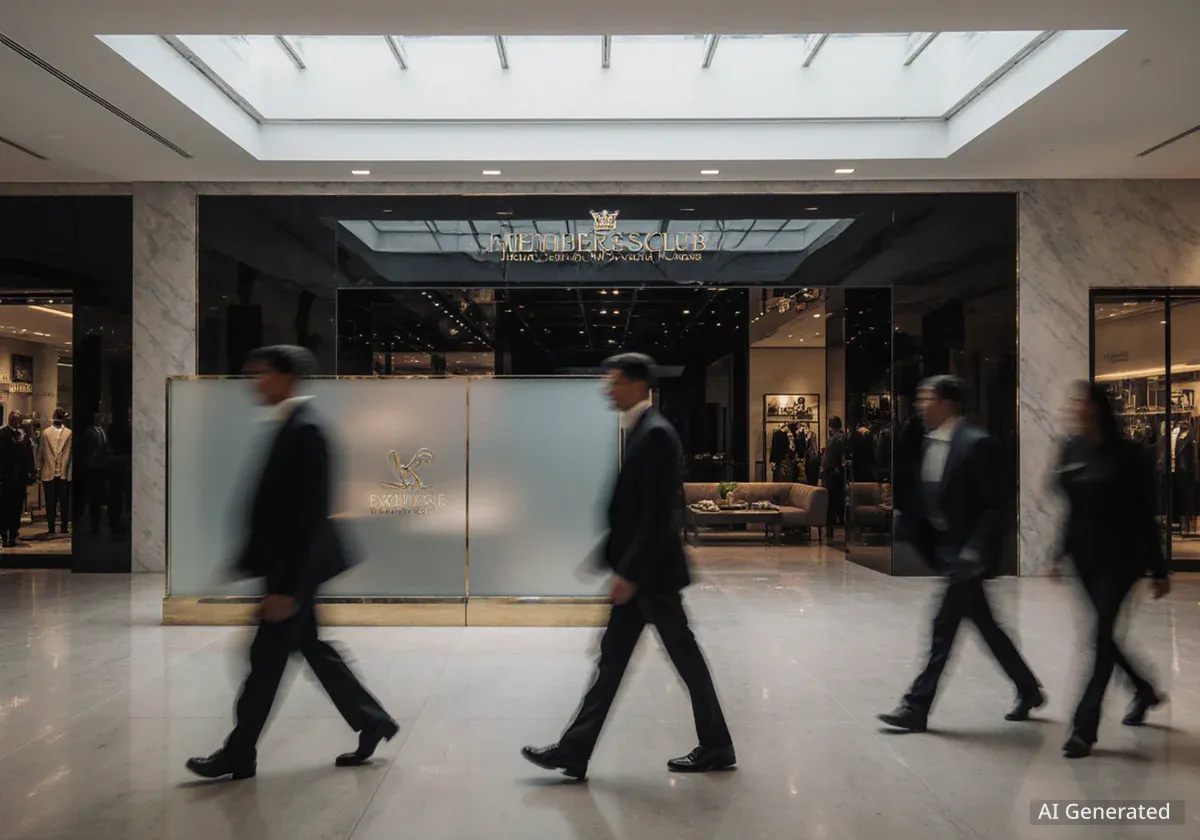
A new trend is reshaping the landscape of high-end retail across the country. Exclusive, members-only social clubs are increasingly taking over large, vacant spaces in luxury shopping centers and open-air malls, offering a novel solution to the challenges of modern commercial real estate.
These establishments, which require steep initiation fees and monthly dues, are becoming the new anchor tenants, promising landlords a steady stream of affluent customers and transforming traditional shopping destinations into exclusive lifestyle hubs.
Key Takeaways
- Private social clubs are becoming a popular choice for landlords to fill large vacant spaces in high-end retail centers.
- These clubs attract affluent members, driving consistent, high-value foot traffic to surrounding stores.
- The trend is expanding from major coastal cities to mid-sized markets like Cincinnati and Grand Rapids.
- For property owners, these clubs offer long-term leases and help position malls as exclusive lifestyle destinations rather than just places to shop.
The Rise of a New Retail Anchor
In an era where traditional department stores are shrinking their footprints, retail landlords are getting creative. The latest strategy involves partnering with private social clubs, which are emerging as a powerful draw for a specific, high-spending demographic.
From Dallas to Miami, these clubs are appearing in upscale shopping villages. At Highland Park Village in Dallas, home to brands like Hermès and Fendi, the Park House club operates with a $7,000 initiation fee and monthly dues of $292. In Miami's Design District, The Moore House charges a $5,000 initiation fee and over $400 in monthly dues.
These are not just dining rooms; they offer curated art experiences, wine bars, and sometimes even overnight accommodations, creating a self-contained ecosystem for their members.
By the Numbers
Membership costs at these new retail-adjacent clubs can be significant:
- Park House (Dallas): $7,000 initiation fee, $292 monthly dues.
- The Moore House (Miami): $5,000 initiation fee, over $400 monthly dues.
- The Social House (Cincinnati): $4,000 initiation fee plus monthly dues.
Why Landlords Are Embracing Exclusivity
For property owners, the appeal of a private club is multi-faceted. They solve the problem of filling large, underutilized spaces, particularly on upper floors of malls or in former anchor store locations. According to Jia Li, an associate professor of marketing at Wake Forest University, this is a strategic move.
"Many malls face challenges filling vacant anchor spaces or underutilized upper floors. A private club can absorb a large footprint while generating steady and recurring traffic," Li explained.
This steady traffic is a key benefit. Unlike a typical shopper who might visit a mall a few times a month, club members often visit multiple times a week. Sam Vise, CEO of Optimum Retailing, notes this high frequency is a game-changer for surrounding businesses.
"It creates a reason to return weekly, sometimes daily, and that spillover benefits surrounding food, wellness, and retail concepts," Vise said. This consistent presence of members with discretionary income is a major incentive for landlords who want to support their other retail tenants.
A Return to Original Purpose
Professor Jia Li points out that this trend brings shopping malls full circle. "Although today we often associate malls primarily with shopping, early shopping malls in postwar suburban America were explicitly envisioned as 'community and civic centers,' not merely retail machines," she said. These new clubs are reviving that original social purpose, albeit in a more exclusive format.
Expanding Beyond the Coasts
While this concept began in elite coastal hubs, it is now rapidly expanding into mid-sized American cities. In Cincinnati, The Social House recently opened next to a bustling retail area. Meanwhile, Grand Rapids, Michigan, is preparing for The Commerce Club, a 55,000-square-foot private club set to open in 2026 in a building that has been vacant for over a decade.
Jeff Lambert, co-founder of The Commerce Club, believes cities like Grand Rapids have reached a critical mass of entrepreneurs and professionals who can support such a venue.
"We deserve something like this that you can experience in Madrid, LA, New York and we can support it. We can create an experience that feels metro but that it is very much local," Lambert stated.
This expansion signals a broader shift in consumer behavior post-pandemic. R.J. Hottovy, head of analytical research at Placer.ai, observed that consumers are gravitating toward more controlled, private environments. "The idea is it's another place, a status symbol. It is exclusivity," he said, noting that private clubs offer a "safe space" for people to gather, similar to the appeal of country clubs.
The Economic Rationale and Future Outlook
The business case for these clubs is strong, especially in the current economic climate, often described as a "K-shaped" recovery where affluent households continue to spend while others pull back.
Daniel Spiegel, a managing director at Coldwell Banker Commercial, sees this as a modern revival of a past trend. "Private social and dining clubs were very popular from the 1950s through the 1990s, and we may be seeing a comeback in different forms," he said. He highlights that these membership-based businesses offer landlords attractive features like longer-term leases and consistent foot traffic during off-peak hours.
However, the model isn't a universal solution. Charlie Koniver, a principal at Odyssey Retail Advisors, cautions that a private club isn't a suitable replacement for every empty big-box store. The concept works best in upscale retail environments that already attract a luxury consumer.
While these clubs can successfully anchor a high-end shopping center, their success hinges on creating a genuine sense of community and value that keeps members engaged. As retailers continue to adapt to a post-ecommerce world, the private club model represents a significant bet on experience and community over pure consumption.