
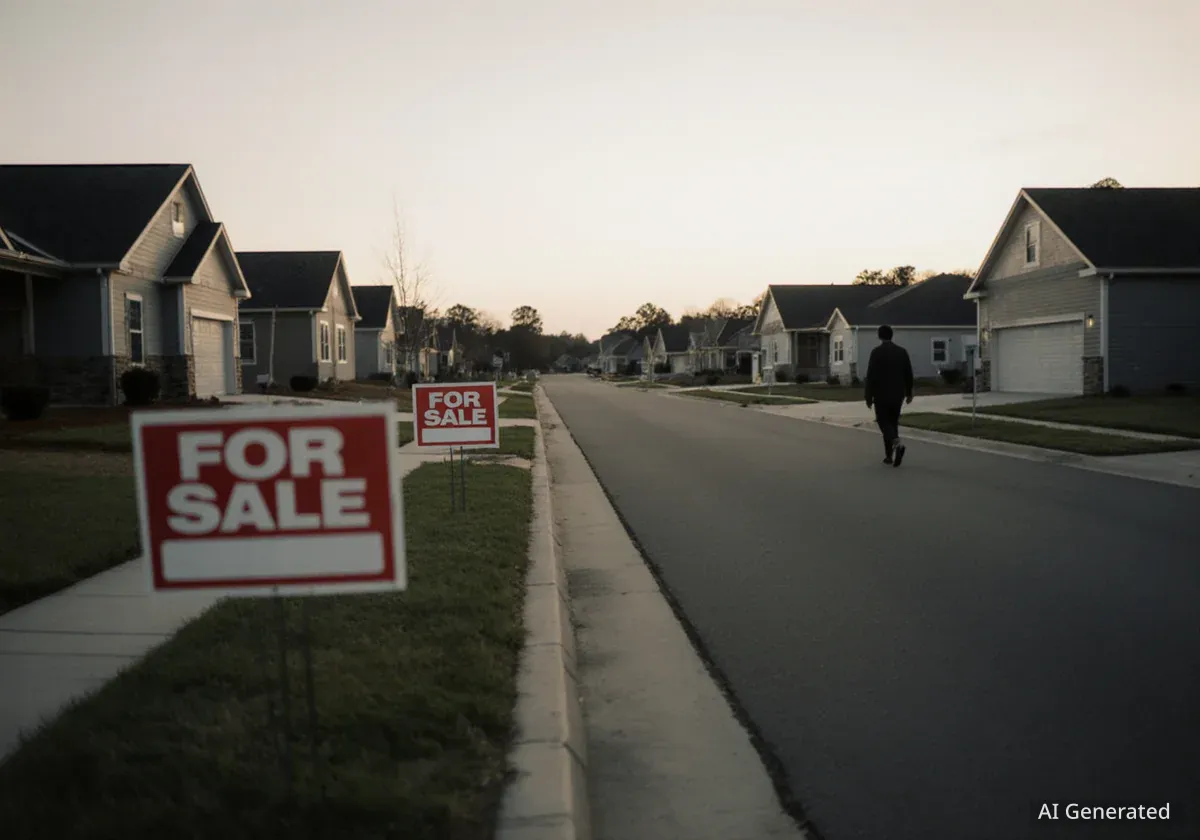
The once-booming housing market across the southeastern United States is entering a new, more uncertain phase. After a period of intense activity, a combination of economic shifts and local pressures is causing a noticeable slowdown, impacting everyone from first-time homebuyers to seasoned developers.
Key indicators, including a significant drop in homebuilder sentiment, point to a market grappling with affordability challenges and evolving economic conditions. While the region remains a popular destination, the dynamics that defined its real estate landscape over the past few years are clearly changing.
Key Takeaways
- The southeastern housing market is experiencing a significant cooling period after years of rapid growth.
- Homebuilder sentiment in the region has fallen to very low levels, signaling caution in new construction.
- Rapidly growing cities like Nashville are facing severe housing affordability challenges that impact residents across income levels.
- Specific sub-markets, such as South Florida's condominium sector, are facing unique headwinds from new regulations and demographic shifts.
- Analysis shows the Southeast is not a single market but a collection of diverse local markets with their own distinct trends.
A Region-Wide Shift in Momentum
The narrative of the southeastern housing market has shifted from one of relentless growth to one of careful observation. The slowdown is not an isolated event but a broad trend felt across multiple states. Economists and real estate professionals are closely monitoring the factors driving this change.
One of the most telling signs is the sentiment among those who build the homes. Confidence among homebuilders has dropped significantly, reflecting concerns about future sales and rising costs. This caution often translates into a slower pace of new construction, which can have long-term effects on housing supply.
Understanding Market Cycles
Housing markets naturally move in cycles of expansion and contraction. The recent "red-hot" period was fueled by low interest rates, high demand, and demographic shifts. The current cooling phase represents a market correction as economic conditions, including changes in borrowing costs, begin to exert their influence.
This transition affects both buyers and sellers. For sellers, the days of multiple immediate offers above asking price are becoming less common. For buyers, while there may be less competition, affordability remains a major hurdle, creating a complex and often frustrating environment.
The Affordability Crisis in Growth Hubs
Nowhere are the market pressures more visible than in the Southeast's fastest-growing metropolitan areas. Cities like Nashville, Tennessee, which have experienced dizzying population and economic growth, are now confronting a severe housing affordability crisis.
The very success that drew people to these cities has pushed housing costs out of reach for many long-term residents and even newcomers. The rapid appreciation in home values and rental rates has created a significant gap between average incomes and the cost of housing.
A Surprising Housing Trend
Recent analysis of available rental units has uncovered a surprising trend. Nearly 40 percent of available rental units were found to be occupied by higher-income households. This suggests that simply building more units may not solve the affordable housing deficit for lower-income families, as new supply is often absorbed by those with greater purchasing power.
This challenge is not limited to low-income households. Teachers, first responders, and service industry workers are finding it increasingly difficult to live in the communities they serve. The issue highlights a growing economic divide and poses a threat to the sustainable growth of these urban centers.
Not a Monolith: Diverse Local Markets
While the cooling trend is widespread, it is crucial to understand that the Southeast is not a single, uniform housing market. It is a diverse collection of local markets, each with its own unique characteristics, challenges, and opportunities. What happens in coastal Florida is very different from what occurs in inland Alabama or Tennessee.
For instance, South Florida's condominium market is facing a distinct set of challenges. New regulations implemented in the wake of safety concerns, combined with shifting demographic preferences, have considerably cooled what was once a red-hot sector. This has created a specific micro-market correction within the broader regional slowdown.
Drilling Down with Data
To truly understand these local variations, analysts rely on detailed information like the Home Mortgage Disclosure Act (HMDA) data. This information provides insights into mortgage lending patterns across different geographies and demographic groups.
Examining this data reveals trends that are not apparent from a high-level view. It can show which communities are seeing more or less investment, how lending patterns differ between urban and rural areas, and where access to credit may be a barrier to homeownership.
Similarly, tools that track commercial real estate activity, such as in northwest Alabama, show fluctuations that reflect local economic health and business investment, further proving that real estate trends must be analyzed at a granular level.
The Human Element: Migration and Displacement
Beyond economic indicators, the housing market is deeply connected to human stories of migration and stability. Natural disasters, for example, can dramatically reshape local housing landscapes and force difficult decisions for residents.
A study of migration patterns in Florida's Panhandle following Hurricane Michael in 2018 provides a powerful case study. The research examined the magnitude of displacement and how housing availability and financial factors influenced where displaced residents relocated.
The findings reveal the significant challenges to successful relocation, particularly the effects on neighborhood inequality and the financial stability of affected families.
This research underscores that housing is more than just a transaction; it is the foundation of community and personal security. Events that disrupt the housing supply can have lasting social and economic consequences, exacerbating existing inequalities.
Looking Ahead: An Evolving Landscape
The southeastern housing market is at a crossroads. The factors that fueled its unprecedented boom have given way to a new set of economic realities. The relationship between federal interest rates and mortgage rates, while not always direct, is playing a key role in shaping buyer behavior and affordability.
As the market continues to adjust, the focus will remain on key areas:
- Affordability: Will wages catch up to housing costs in major metro areas?
- Supply: How will builder sentiment affect the availability of new homes?
- Local Variation: Which sub-markets will prove most resilient, and which will face the biggest corrections?
For now, the era of easy gains and rapid appreciation appears to be over. The coming months will require a more nuanced understanding of a complex market that is no longer moving in just one direction.