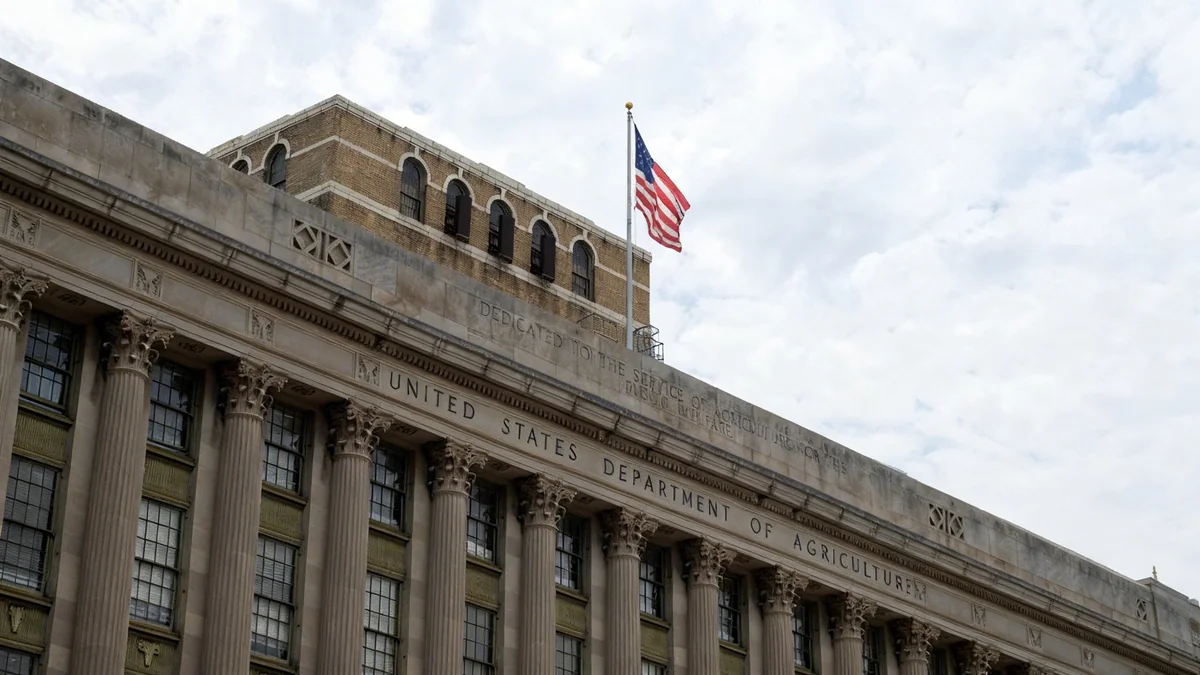
The U.S. Department of Agriculture (USDA) is handing over large portions of its South Building headquarters in Washington, D.C., to the General Services Administration (GSA) amid plans to relocate about half of its local workforce. The move highlights a broader reevaluation of the federal government's real estate footprint, as the federal judiciary simultaneously petitions Congress for control over its own deteriorating courthouse buildings.
Key Takeaways
- The USDA is vacating parts of its South Building headquarters, which is over 70% unoccupied on any given day.
- The building faces a staggering $1.6 billion backlog in deferred maintenance.
- Approximately half of the USDA's Washington, D.C. workforce will be relocated to five new regional hubs across the country.
- Separately, the federal judiciary is asking Congress for authority to manage its own courthouses, citing an $8 billion repair backlog and significant safety concerns.
An Empty Building Prompts Major USDA Shift
The decision to consolidate the USDA's presence in the nation's capital stems from the stark reality within its South Building. The massive facility is largely deserted, with officials reporting that more than 70 percent of the space is unoccupied on a typical day. This underutilization is compounded by severe infrastructure issues.
The building currently has a deferred maintenance backlog estimated at $1.6 billion. The state of the building was described vividly by Agriculture Secretary Brooke Rollins.
"If you were to walk in the South Building today, here’s what you would find: empty office, after empty office, after empty office," said Rollins.
The GSA, which acts as the federal government's landlord, will now take control of the vacated space. The agency plans a measured approach to determine the building's future, which could include an outright sale to the private sector. GSA Administrator Edward Forst emphasized a collaborative process, stating, "We want to be good listeners, and then we'll execute on this."
A National Relocation Strategy
The consolidation in Washington, D.C., is part of a larger plan to decentralize the USDA's operations. The department intends to move roughly half of its current D.C.-based employees to new locations across the United States.
Half of DC Workforce to Move to New Hubs
The relocation effort will affect a significant portion of the USDA's staff. The department has established five new regional hubs to house these employees, strategically placed throughout the country.
The designated hub locations are:
- Raleigh, North Carolina
- Kansas City, Missouri
- Indianapolis, Indiana
- Fort Collins, Colorado
- Salt Lake City, Utah
Officials are aiming for a smooth transition for the families involved. USDA Deputy Secretary Stephen Vaden outlined the timeline, focusing on minimizing disruption to the school year.
"Our goal is to have our employees complete the school year here in Washington, D.C., and be in place in their new hub locations at the time school starts in those new hub locations," Vaden explained. The department has stated it will inform affected employees of their new assignments in the coming months.
Judiciary Demands Control Over Crumbling Courthouses
While the USDA downsizes its physical footprint, another branch of the federal government is fighting for more control over its own buildings. The federal judiciary is actively lobbying Congress to pass legislation that would transfer management of the nation's federal courthouses from the GSA to the Administrative Office of the U.S. Courts.
The request is driven by what the judiciary describes as a crisis in building maintenance. According to the Administrative Office, there is more than $8 billion worth of "delinquent infrastructure repairs" needed in courthouses across the country.
Safety and Security at Risk
The judiciary has pointed to several alarming incidents as evidence of the deteriorating conditions, including a ceiling that collapsed during a trial, frequently stuck elevators, and widespread mold issues. They argue these problems pose direct risks to safety, security, and the continuity of court operations.
In a formal communication, Director Judge Robert Conrad Jr. warned of the escalating consequences of inaction. "Without immediate action, the problems will continue to worsen," he wrote. "Action is needed now to reverse a downward spiral of critical-system failures, long-term underfunding of repairs, security risks, and climbing costs."
The judiciary also attributes some of the accelerating problems to recent departures in GSA staff.
GSA Defends Its Management
The GSA has pushed back against the judiciary's characterization of the situation. While acknowledging the challenges posed by aging federal buildings, the agency contends that the judiciary's narrative is incomplete.
Marianne Copenhaver, GSA's associate administrator for strategic communications, stated that a key part of the problem has been omitted. "While aging federal buildings present well-known challenges, their narrative omits critical context regarding our lack of access to GSA’s Federal Building Fund to address delinquent maintenance," she said.
This dispute sets the stage for a potential legislative battle over the management of critical federal infrastructure, placing the responsibility for billions of dollars in repairs and the future of hundreds of federal buildings at the center of debate in Congress.