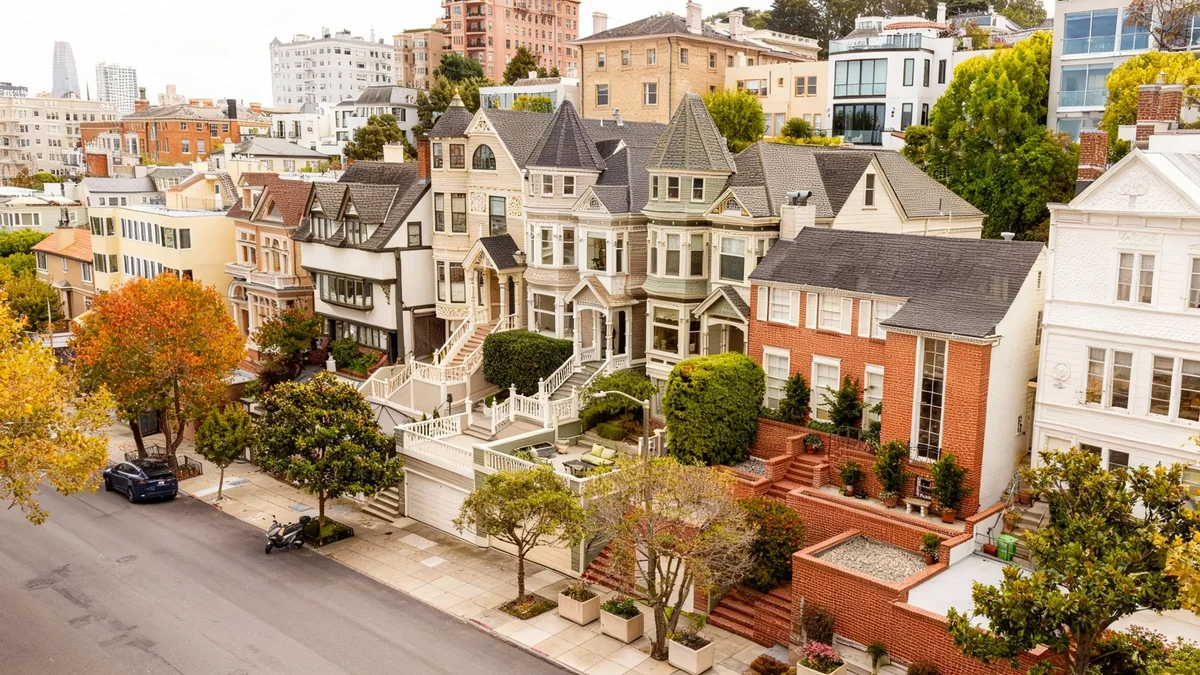
The San Francisco residential real estate market experienced a dramatic turnaround in 2025, shaking off a slow start to the year to post record-breaking sales in the fall. The city's burgeoning artificial intelligence sector is credited with fueling a surge in high-end property transactions, signaling a potential new era of tech-driven wealth shaping the city's landscape.
After a sluggish spring marked by economic uncertainty, the market gained significant momentum in the latter half of the year. This culminated in a series of multimillion-dollar deals, including the third-largest residential sale in San Francisco's history, as a new wave of tech executives and investors entered the buying pool.
Key Takeaways
- San Francisco's real estate market saw a slow spring followed by a supercharged fall in 2025.
- The city's booming AI industry was the primary driver behind the market's recovery and high-end sales.
- October 2025 recorded the highest number of sales over $5 million in four years.
- A $42 million sale on Billionaire's Row became the most expensive home sold in the city for the year.
- Experts anticipate the market could heat up further in 2026 with several major AI company IPOs expected.
A Year of Contrasting Fortunes
The year began with a handful of significant sales, but momentum quickly stalled. By early February, widespread economic uncertainty related to potential trade tariffs caused many prospective buyers to pause their search. The typically bustling spring season, which often sets the price benchmarks for the rest of the year, failed to materialize.
However, as the year progressed, confidence returned, largely powered by the rapid growth of San Francisco's AI economy. By late summer, the market had reversed course. House hunters returned in force, but they were met with limited inventory, leading to competitive bidding wars and offers that frequently exceeded asking prices. This created a frenzied atmosphere, particularly in the luxury segment.
Luxury Market Reheats
According to data from Compass, October saw more residential sales above the $5 million mark than any month in the previous four years. The majority of these high-value transactions were concentrated in affluent northern neighborhoods like Pacific Heights and Presidio Heights.
This resurgence demonstrated a clear shift in market dynamics. While the broader market is still recovering from post-pandemic price adjustments, the high-end sector is showing signs of exceptional strength, driven by a specific, cash-rich demographic tied to the AI industry.
The Epicenter of AI Wealth
A key factor distinguishing this real estate boom from previous tech-driven cycles is the location of the companies themselves. Unlike the dot-com era, where the tech hub was firmly in Silicon Valley, today's leading AI firms like OpenAI and Anthropic are headquartered within San Francisco.
This geographical shift has had a direct impact on neighborhood desirability. "In the last boom, Noe Valley and Bernal Heights were so popular because everybody needed to get to Mountain View and Cupertino," explained broker Karen Mendelsohn Gould. "This time, so much is happening in San Francisco. So much is happening in Jackson Square. Now you can live on the north side and still be really close to work."
Commute-Free Convenience
The proximity of AI headquarters in neighborhoods like the Mission District and Jackson Square has made northern San Francisco neighborhoods more attractive than ever. The appeal of a short commute, or none at all, is a significant draw for highly compensated tech executives, pushing up demand for luxury homes in areas that were once considered less convenient for Silicon Valley commuters.
This trend is reflected in market data. Patrick Carlisle, chief market analyst at Compass, noted that by nearly every indicator of supply and demand—including price appreciation, overbidding, and speed of sales—San Francisco is a standout market. "It is certainly the standout market in the Bay Area," he said, "though the Silicon Valley markets are also still very strong."
Record Sales and a New Appetite for Risk
The renewed market optimism was epitomized by the year's largest transaction: the sale of a home on Billionaire's Row for $42 million. The off-market deal, which was the third-largest in the city's history, involved a property that had not changed hands in over 50 years. The buyer was an LLC linked to Katie Schwab Paige, daughter of finance magnate Charles Schwab.
The willingness of buyers to invest such substantial sums in San Francisco real estate, even for properties requiring extensive renovation, underscores the current market confidence.
"People are willing to take on quite a big fixer," said Nina Hatvany of Compass, who recounted a client being outbid on a Presidio Heights home listed under $6 million that ultimately sold for $7.3 million within weeks.
This trend of purchasing fixer-uppers at a premium, along with a renewed interest in downtown condos, suggests buyers are betting on the long-term value of San Francisco real estate, buoyed by the wealth generated from the AI sector.
Looking Ahead to 2026
As 2025 concluded, market analysts were already looking toward what could be an even more active 2026. A primary driver of this optimism is the anticipation of initial public offerings (IPOs) from several major AI companies, including OpenAI, Anthropic, and Databricks.
These IPOs are expected to create a new class of millionaires and billionaires, injecting a significant amount of capital into the local economy and, by extension, the real estate market. If these public offerings proceed as predicted, the demand for luxury properties could intensify further.
While the market remains susceptible to broader economic shifts, the concentration of AI wealth within San Francisco has created a powerful, localized force. For now, all signs point to a continued upward trend in the city's high-end property market, driven by the innovators and investors at the forefront of the artificial intelligence revolution.