
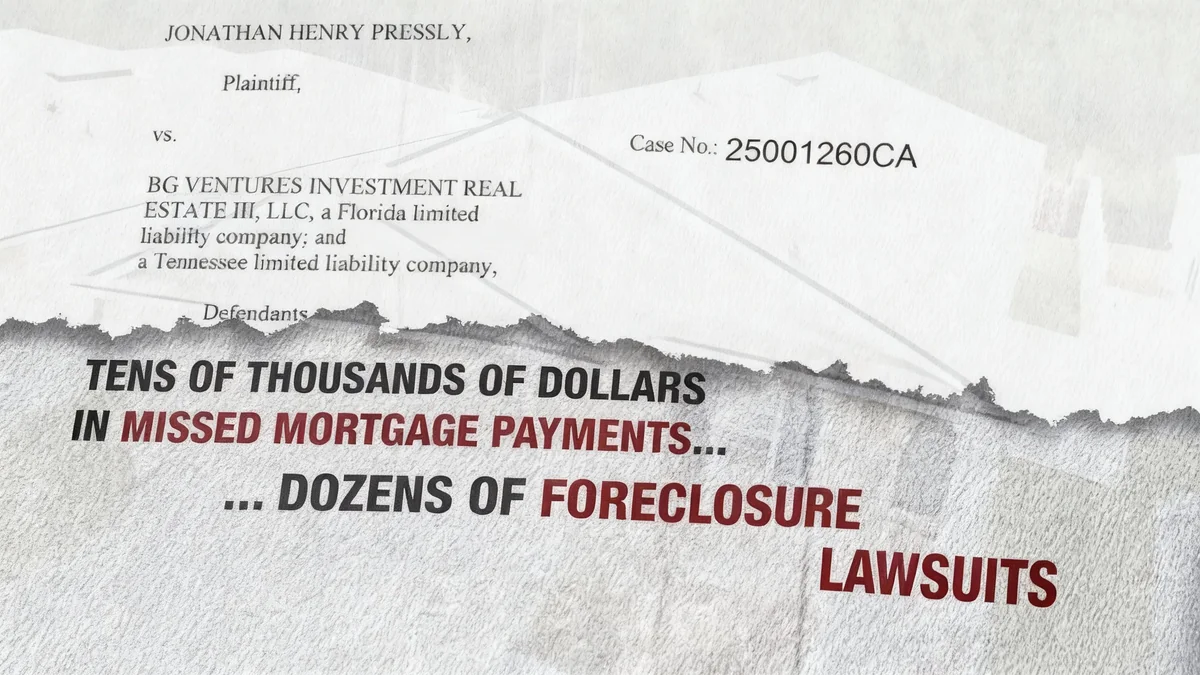
Dozens of homeowners across Florida are facing foreclosure and financial ruin after entering into a controversial type of real estate transaction known as a “subject-to” mortgage deal. An investigation has uncovered a pattern of missed payments and legal battles linked to a single investment firm, leaving sellers legally responsible for mortgages on homes they no longer own.
The company at the center of these transactions, BG Ventures Investment Real Estate, is now connected to at least 32 foreclosure lawsuits across the state. Homeowners who believed they had found a solution for their financially distressed properties are now grappling with damaged credit, mounting legal fees, and the loss of their homes.
Key Takeaways
- Homeowners in Florida are facing foreclosure after engaging in "subject-to" mortgage deals where the original mortgage remains in their name.
- An investment firm, BG Ventures, is linked to at least 32 foreclosure lawsuits for allegedly failing to make promised mortgage payments.
- Sellers, like retired servicemember Jonathan Pressly, report being left to pay mortgages on properties they no longer possess to avoid severe financial consequences.
- Legal experts advise extreme caution, suggesting protective measures like placing the deed in a trust before entering such agreements.
The Promise of an Easy Exit
For homeowners struggling to sell a property with little to no equity, the offer can sound like a perfect escape. In a "subject-to" transaction, a buyer takes ownership of the property by accepting the deed, while promising to take over the existing mortgage payments. The critical detail is that the loan itself does not get transferred; it stays in the seller's name.
While legal, this arrangement creates significant risk for the original homeowner. If the new owner stops making payments, the lender will pursue foreclosure against the person whose name is on the mortgage—the seller.
This is the exact situation numerous Florida residents now find themselves in. Court records reveal a trail of defaulted loans and legal actions connected to properties acquired by BG Ventures, also known as BG Investment Group.
By the Numbers
Public records show a significant financial fallout from these deals, with at least 29 active foreclosure lawsuits and tens of thousands of dollars in missed mortgage payments tied to properties involved with BG Ventures.
A Pattern of Default Emerges
The business model employed by the investment firm appeared to rely on a specific rental strategy. According to legal filings and interviews, the plan was to convert single-family homes into co-living spaces, renting out individual rooms to maximize rental income. This approach, often associated with platforms like PadSplit, was intended to generate enough cash flow to cover the mortgages and produce a profit.
To fund these acquisitions, BG Ventures allegedly turned to private money lenders, promising them high returns of 15% to 20%. However, these investors were often placed in a second-lien position, meaning the original mortgage had to be paid first. When the payments stopped, both the original homeowners and the private investors were left in a precarious financial position.
'Everything Just Seemed Good'
Jose Landeros and Christian Mendez, first-time homeowners in Duval County, were facing an upside-down mortgage when they were approached by BG Ventures. The deal seemed straightforward and beneficial.
"We were like, OK, this seems like a pretty good deal," Landeros said. "They were making this deal on like an upside-down kind of purchase. But we got money out of it, so that seemed great."
The couple received $13,000 in cash at closing and were told the company would handle the mortgage payments by renting out the rooms individually. "Everything just seemed good," Landeros recalled. But soon, the mortgage company started calling about missed payments.
"That’s when it started clicking, something’s wrong," he said. The couple later learned from neighbors that no one ever appeared to move into the house. They continued to receive violation notices from the homeowners' association for an unkempt lawn on the property they thought they had sold.
What is a 'Subject-To' Deal?
In a "subject-to" real estate transaction, a buyer takes title to a property, but the existing loan stays in the seller's name. The buyer agrees to make the payments. This differs from a traditional sale, where the seller's mortgage is paid off and the buyer obtains new financing. The primary risk falls on the seller, who remains legally liable for the debt.
The Human Cost of a Failed Venture
The consequences have been devastating for many. In Bay County, retired military servicemember Jonathan Pressly is now suing BG Ventures for fraud. He needed to sell his Panama City home quickly while transitioning out of active duty and felt pressured into the deal.
"I didn’t have another job completely lined up. I needed to get this house off of me right now," Pressly explained. He alleges that after he signed over the deed, the company made no effort to pay the mortgage.
"They made zero payments," Pressly stated. "No attempt to make a payment."
To protect his military security clearance and his current job, Pressly has been forced to continue paying the mortgage on a home he no longer owns. A foreclosure on his record could have catastrophic professional consequences. "I felt like I was doomed," he said. "It’s an absolutely horrible situation."
Even real estate professionals involved in the deals are expressing regret. One agent, who asked to remain anonymous, facilitated approximately 60 transactions for BG Ventures. He initially believed he was providing a viable solution for sellers in difficult situations.
"The intention was only to help sellers and provide an actual solution," he said. Now, witnessing the fallout, he feels a heavy burden of responsibility. "I feel so horrible," he admitted.
Protecting Yourself from Risky Deals
Consumer advocates and legal experts are urging extreme caution for any homeowner considering a subject-to agreement. The allure of a quick sale and immediate cash can obscure the long-term risks.
Attorneys suggest several protective measures sellers can take:
- Seek Independent Legal Counsel: Before signing any documents, have an experienced real estate attorney review the contract.
- Use a Trust: Place the property deed into a trust. If the buyer defaults on the loan, the deed can revert to the seller, providing a clearer path to regaining control of the property.
- Delay the Deed Transfer: Include a clause in the contract that the deed will only be transferred after the buyer has made a specific number of on-time payments, such as 12 consecutive months.
As these cases work their way through the Florida court system, they serve as a stark warning. While a subject-to deal can be a useful tool in certain circumstances, it places immense trust in the buyer. When that trust is broken, the seller is the one who bears the full weight of the consequences.
Repeated attempts to contact BG Ventures for comment on the numerous lawsuits and allegations were unsuccessful.