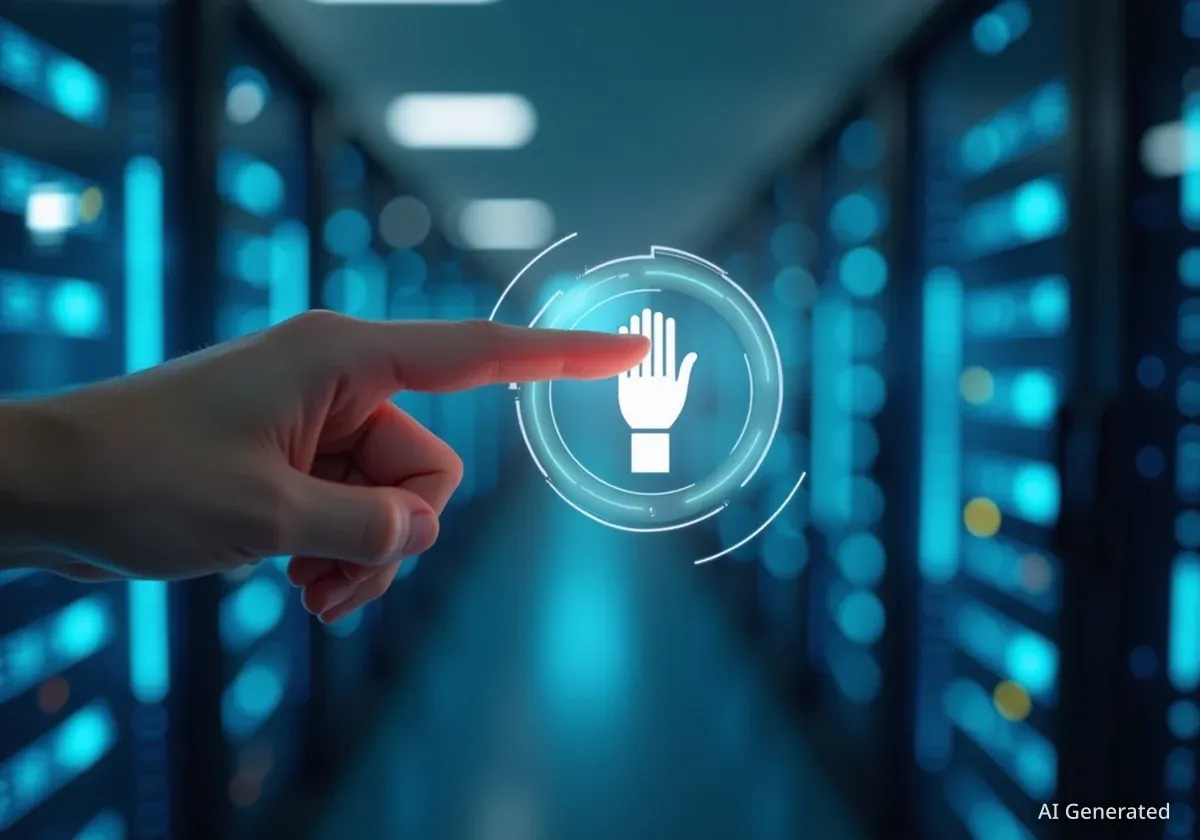

If you've recently been asked to 'press and hold' a button on a website to prove you're human, you're not alone. This emerging security check is part of a growing technological arms race between websites and increasingly sophisticated automated bots, signaling a major shift in how companies protect their platforms and data.
These advanced verification methods are becoming more common as older systems, like distorted text and image-based puzzles, struggle to keep up with bots designed to mimic human behavior. The new interactive challenges aim to analyze subtle user actions that are difficult for automated programs to replicate, but they also raise questions about user convenience and accessibility.
Key Takeaways
- Websites are adopting new interactive security checks, such as 'press and hold' captchas, to combat advanced automated bots.
- Traditional CAPTCHA methods are becoming less effective as bots evolve to solve them.
- These new systems analyze behavioral biometrics like pressure, timing, and mouse movement to distinguish humans from machines.
- The shift represents a trade-off between enhanced security against fraud and potential frustration for legitimate users.
The Escalating Fight Against Sophisticated Bots
The internet is teeming with automated programs, or bots, and not all of them are benign. Malicious bots are responsible for a wide range of disruptive activities, from scraping website content and creating fake accounts to executing large-scale cyberattacks like credential stuffing, where stolen login information is used to gain unauthorized access to user accounts.
In the past, simple challenges like typing distorted words or clicking on images of traffic lights were enough to stop most automated scripts. However, advances in artificial intelligence and machine learning have enabled developers to create bots that can easily bypass these traditional hurdles. Consequently, security providers have been forced to innovate.
What is a CAPTCHA?
CAPTCHA stands for "Completely Automated Public Turing test to tell Computers and Humans Apart." Its primary goal is to create a test that is easy for a human to pass but difficult for a computer program. The effectiveness of these tests is constantly being challenged by evolving AI.
Modern security systems now focus less on what you know and more on how you behave. They analyze a stream of data points in the background, including mouse movements, typing rhythm, and how you interact with elements on a page. When a user's behavior is flagged as suspicious, a more direct challenge is presented.
From Image Puzzles to Behavioral Analysis
The evolution of user verification has been rapid. Many users are familiar with Google's reCAPTCHA, which often requires just a single click in a box that says "I'm not a robot." This system works by analyzing user behavior before the click even happens. If the system is confident you're human, you pass instantly. If not, you're presented with a visual puzzle.
The 'press and hold' mechanism is the next logical step in this evolution. Instead of a simple click, it requires a continuous interaction that can be measured for authenticity. Security platforms can analyze several metrics during this simple action:
- The duration of the press.
- The pressure applied (on touch-screen devices).
- Minute movements of the cursor or finger during the hold.
- The speed and path of the cursor approaching the button.
These subtle behavioral biometrics are incredibly difficult for a simple script to fake. A bot might be programmed to 'click' or 'hold for 2 seconds,' but it's much harder to program it to replicate the micro-variations inherent in human muscle control.
"We're moving from a binary 'pass/fail' test to a more nuanced, risk-based assessment of user behavior. It’s not just about the final action, but the entire journey of interaction on the page," explained one cybersecurity analyst.
The Balance Between Security and User Experience
While these advanced measures are effective at thwarting bots, they come at a cost to the user experience. Legitimate users can find these interruptions frustrating, especially if they are frequently challenged. For some, the instructions may not be immediately clear, leading to confusion and potential abandonment of the site.
There are also significant accessibility concerns. Users with motor impairments or those who rely on assistive technologies may find a 'press and hold' action difficult or impossible to perform. As these security measures become more widespread, companies must ensure they provide alternative verification methods to avoid excluding segments of their user base.
The Economic Impact of Malicious Bots
According to industry reports, bad bot traffic can account for nearly a quarter of all internet traffic. These bots are linked to billions of dollars in losses annually from activities like ad fraud, inventory hoarding, and data theft, making advanced security a critical investment for online businesses.
The goal for security providers is to create a system that is as frictionless as possible for the vast majority of human users while remaining a formidable barrier for bots. This is why many of these systems operate invisibly in the background, only presenting a direct challenge when a user's activity deviates from typical human patterns.
What's Next for Digital Identity Verification?
The 'press and hold' button is just one example of the new frontier in online security. The industry is continuously exploring more passive and sophisticated ways to verify human identity without interrupting the user's journey.
Future methods may rely more heavily on device fingerprinting, continuous behavioral analysis throughout a session, and even biometric data from smartphones like gait analysis or typing patterns. The ultimate aim is to make security checks so seamless that the user doesn't even notice they are happening.
For now, however, users can expect to see more of these interactive challenges. The next time a website asks you to press and hold, you'll know it's part of a complex, invisible battle to keep the digital world secure from a growing army of sophisticated bots.